Thursday, April 11, 2013

Q&A with FIRST Coach Sherry Batin: "Have Patience."


The Bishop-Wisecarver family of companies is proud to be recognized as a FIRST Robotics Competition Diamond Supplier this year — we're even more proud of the great work accomplished by the teams we sponsor. Both the students and the mentors are an inspiration to us all, and it's an honor to share their story.

This week, we'd like to feature Sherry Batin, the assistant coach for the Fembots team #692, who was eager to share her experiences about FIRST with us: what compelled her to get involved and how she was able to fill the role of a FIRST coach.

A mechanical engineer by training, Sherry clearly had the technical skills for the position, but per the organization's founder Dean Kamen, FIRST is about "...more than just building a robot." See what Sherry had to say about what it takes to be a successful FIRST mentor!


Question: What made you decide to become a FIRST coach and what have you gained
from this experience?

SB: After some unusual circumstances that happened to the team the previous year, I wanted the
students on the team to know that there will always be someone there to support them. Really, I
did it for the students, because they needed someone to lead them, especially when they started
to think no one wanted to be their coach.

I didn't think I was grown up enough to lead a group of high school students and handle such a large endeavor, but they needed someone; I bit the bullet and took on this huge role. Although, I put myself aside to take on this big job for the team, and I gained a load of new experiences. I became more confident in myself and my abilities to lead people. I learned to not hesitate when planning needed to happen and that with a “grown up” role I should always be the first to act.

Question: We recognize that FIRST is not just about kids building a robot. What else does this competition mean for you as a coach? What else does this competition mean for the
kids?

SB: FIRST is a lot more involved than your typical after school club. So many things have to happen at the same time for a FIRST team to do what it needs to do, but the most important are the
relationships it creates because it's a chance for students to participate with professionals in their field (engineers or otherwise). It's where true mentorship happens. Students get this rare chance to hear about what these professionals did to reach the point that they're already at in their
careers while creating a relationship with these adults.

Question: As a FIRST coach, what have you learned about yourself, particularly in regards
to your strengths and weaknesses?

SB: I have learned a lot about my interpersonal skills. I have been told that I have this commanding air that the students find comfort in following; people management seems to come easily to me. However, I also think that my interpersonal skills need more work. I think that may be because I am neither a teacher nor a parent, but it something that I will continue to work on.

Question: Which aspect(s) of the FIRST Robotics Competition are you most excited about?

SB: I personally love the three days worth of competitions. I enjoy the fast paced atmosphere where
quick thinking and problem solving skills are most important. I also enjoy being able to see what
other teams have created to solve the same design problem presented to everyone at the beginning of January.

Question: What is your favorite aspect of being a coach?

SB: I love story time. I like sharing stories, stories that can inspire the students, anecdotes to share when things start to seem bleak and tiring. It doesn't matter if it's my own personal story or stories I've heard from other teams or people. I want my students to understand that as unique as this team can be, there are thousands of other teams, thousands of other students going through similar experiences. I want to remind my students that although our experiences are special to us, there are other examples and experiences that we can gain inspiration from.

Question: What advice do you have to give to future or other FIRST coaches?

SB: Have patience. As much as we adults want to do everything for the students; as much as it would save time and money to do it ourselves, that's not the point of this program at all. So FIRST coaches, have patience. Guide them through the process, but the important thing is that they get to the end result themselves.

Question: What do you think the future of FIRST is, and of STEM in general?

SB: I want to see FIRST continue to grow. I have been affiliated with FIRST since 2002 and it has grown so much already. I want to continue to be involved for 10 more years. As huge as this program is, the interest in STEM (science, technology, engineering, and math) is still small.

Too many people discover the magic of STEM later, and it would be amazing to see more young people be interested in STEM sooner. Somehow, young people need to stop being afraid of math and science...

Question: Is there anything else about FIRST that you’d like to share?

SB: FIRST gives you such awesome experiences, adults and students alike. I would encourage
anyone to become involved in FIRST.

Tuesday, April 9, 2013

FIRST Team The Fembots Tour the Bishop-Wisecarver Facility

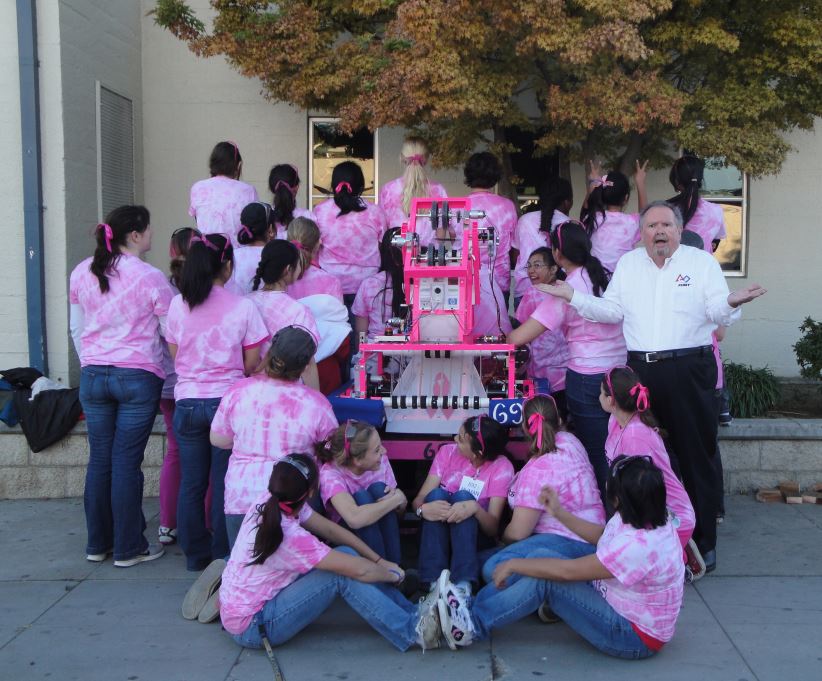
Part of the Bishop-Wisecarvear team guided the ever-enthusiastic Fembots, FIRST Robotics Competition (FRC) Team 692, through our California-based facility last week. The all-girls team from St. Francis High School in Sacramento has an unending thirst for learning, and for, well, the FIRST, a non-profit robotics program geared at “…transforming our culture by creating a world where science and technology are celebrated and where young people dream of becoming science and technology leaders."

Those great words come from Dean Kamen, an American inventor and co-founder of FIRST.
Our Vice President of Manufacturing, Aldo DeAmicis, and our Product Manager, Brian Burke, led groups through the facility, describing products, processes, and equipment.

We caught up with the Fembots after their tour to hear what they were thinking and to answer any of their follow-up questions. The post-tour discussion began with technically-oriented questions that ranged from curiosity about the manufacturing floor to more FIRST-geared discussion with Pamela Kan, our company president.

 “A lot of people are really surprised when we tell them that we’re girls and we’re participating in FIRST,” one of the team members from the audience explained to Kan.

Kan nodded in agreement: “Girls can solve problems too,” she noted, “Oftentimes in ways that are much more different than men. Girls are creative, too.”

Kan then posed several questions to the Fembots team.

“Did you like learning tactically, in a hands-on type of environment?”

A series of “yeahs” emerged from around the room, with many team members nodding in agreement.

“What did you like best about FIRST?” Kan ventured.

“I like how you learn all of this stuff,” one student offered.

One of the team members raised her hand and offered her answer to Kan’s question.

“My favorite thing about FIRST is that I was able to write my college essay about being on a FIRST team. Because of that essay, I got a lot of personal responses to my college applications, and I also ended up getting a lot of scholarships. Actually, I got into my top choice school — U.C. Davis.”'

Kan nodded, smiling. “And this is why we believe in the event,” Kan later shared. “It is because of the infectious hope it offers and the starting point it provides for kids who want a future in science, technology, engineering, and math.”

Kan concluded the Q&A session by saying, “My favorite thing about FIRST is that you do everything in teams — because in work, at a job, you work in teams. FIRST is just like the real world, and it’s tough to get that type of hands on education anywhere else.”

Sunday, March 24, 2013

[ VIDEO ] 2013 First Robotics Competition Sacramento Regional

Bishop-Wisecarver is proud to be a Diamond Supplier this year of the FIRST Robotics Competition (FRC) — we're even more proud of the teams we sponsor. Their hard work is an inspiration to us all, and it's an honor to share their journey's with you.

In this video you will see exclusive coverage shot by the BWC team on Friday, March 22 in Davis, California. You will also meet two team members from the Fembots #692.

Tuesday, March 12, 2013

Q&A with Northern California FIRST Senior Mentor Teri Benart


Bishop-Wisecarver is proud to be a Diamond Supplier this year of the FIRST Robotics Competition (FRC) — we're even more proud of the teams we sponsor. Their hard work is an inspiration to us all, and it's an honor to share with you their story.

This week, we'd like to feature Northern California FIRST Senior Mentor Teri Benart. Although she is busy participating in regional competitions, Teri took time out to meet with us for a Q&A session. Have questions for her? Leave 'em in our comments section!

Question: Almost anyone involved in FIRST has the opportunity to be a mentor. Sometimes it’s mentors guiding students, students helping students, and students advising mentors—do you have words of wisdom to share with teams who have just joined FIRST this season?

Answer: My advice to students would be to leverage the veteran teams to help you through the FIRST build season. It’s always a challenge to learn how to get this done. Secondly, utilize all of your resources, including the FIRST website, and the Non-Engineering Mentor Organization (NEMO) website as well. Chief Delphi is also a great website, and that is a blogging area where teams discuss their designs and challenges. Chief Delphi is a great site for teams to connect with other teams.

Question: We recognize that FIRST is not just about kids building a robot. What else does this competition mean for you as a mentor? What else does this competition mean for the kids?

Answer: It keeps me open-minded as a mentor and informed as to what kids are thinking these days. I get a lot of satisfaction out of watching kids get it, and when I say “get it”, I mean watching kids be part of a team; it’s just amazing to me.

I have a firsthand experience with my son who is going into mechanical engineering. He is a freshman at the University of Nevada in Reno. One of his closest friends is at University of California Santa Barbara studying mechanical engineering also. I think what’s most interesting is that all the friends he hung out with on his FIRST Robotics team are all studying engineering at different schools—all five of them. My son did FIRST Robotics for all four years.

What happened was that he and one friend (who is now studying engineering at Cal Poly) grabbed their other friends after doing FIRST their freshman year, and maintained a consistent group throughout their sophomore, junior, and senior years as FIRST participants. It was a great experience for me as mom because I was a mentor for the team up until this year.

In the 2009 game, my son asked me to go with him to the kick-off and from that moment on I was hooked. I also am the chairperson for the UC Davis Regional in addition to being the Northern California Senior Mentor. I’m working on doing Junior FLL with my grandson, who is 8 years old. I was just visiting him this weekend, and we were building a Lego robot. I love watching kids get excited about the process of creation.

Also, I've noticed that there are a lot of girls I know who never would've done what they’re doing without going into this program. How many girls grow up dreaming of using power tools? After getting into this activity, many girls end up realizing that they actually enjoy it. It (FIRST) helps them to apply knowledge.

For example, my son up at college needed to build a hovercraft, my son was able to recommend the appropriate material with which to build the hovercraft.

Question: As a FIRST mentor, what have you learned about yourself, particularly in regards to your strengths and weaknesses? (This could be particular technical skills, knowledge, or personal skills).

Answer: What I've learned about my strengths is that I am really a strong planner. I really keep the kids on track from a planning perspective, whether we are talking about financial planning, project planning, or meeting deadlines.

What the kids have taught me the most is to keep an open mind and that anything is possible. They've shown me over and over again that the things I think won’t work will work.

Question: Which aspect(s) of the FIRST Robotics Competition are you most excited about?

Answer: The Chairman’s Awards because it talks about sustainability, longevity, and business continuity for the team. It tells me that these kids are thinking about something other than building a robot.

Question: What is your favorite aspect of being a mentor?

Answer: Probably dancing with the kids and having fun. Watching them be happy and continually grow. I love getting up and dancing with them at Regionals and wearing silly things.

Question: What advice do you have to give to future or other FIRST mentors?

Don’t underestimate the power of the kids because those kids are amazing. They really know how to inspire me. I think they inspire me more than I inspire them.

Question: What do you think the future of FIRST is, and of STEM in general?

Answer: I think that the future of FIRST is a decentralized model where the corporate. FRC will become more like FTC and FLL. FIRST is getting so big.

Regarding STEM in general, I think that there is so much attention on STEM that I think that more and more kids will go into STEM. I think that project-based learning— which is what FIRST teaches— is more of what the public sector will begin to lean towards and evolve into. I don’t think we can continue to pound our kids with information and expect them to learn without any experiential process. My hope is that STEM influences project-based learning in public schools.

Question: Is there anything else about FIRST that you’d like to share?

I think that it’s a great organization. I know they’d like to see it move faster than it has been but let’s think about it—it’s been 22 years and this program is exploding. I think that in the short duration it’s been around that there has been phenomenal growth.

Friday, March 8, 2013

Top Five Tweets of the Week: Robotics Growing in Popularity and the Future of Manufacturing in 3D


Wow! Did the week fly by just as fast for you as it did for us? Well, in case you missed the latest and greatest in news shared on Twitter, here's our top five favorite posts from this week — from robotics making one of the hottest trends in 2013 to a Q&A with one of our very own. Wishing you a wonderful weekend!

1. 3D Printing and the Future of Manufacturing via IndustryWeek: Years back, it took a tremendous amount of capital investment and time to train to become a graphic designer. Within the last decade, however, advances in digital printing and software have made the design trade more ubiquitous and accessible than ever before. Now, a similar shift is occurring within the manufacturing field: "Today, almost anyone can become a manufacturer or contribute to the manufacturing process," explains this infographic.

Credit: Forbes
2. Robotics is One of the Hottest Trends of 2013 via Forbes: Robotics are fast tracking up the ladder of importance in everyday lives. Self-driving cars, robotic surgery and robotic exoskeletons for soldiers are indeed serious stuff. Even toymakers like Lego are moving from the ranks of hobbyists to make a huge difference in people’s lives. Case in point is the partnership between FIRST LEGO League (FLL), Trophy Computers & Robotics, and SAP in South Africa.

3. Q&A with Texas Regional Sales Manager Chris Haltom via BWC: Chris joined the Bishop-Wisecarver team at the beginning of the year, bringing with him a wealth of enthusiasm!

4. Manufacturers Seek to Engage Kids via @JELDWEN on Twitter: Get chalk and draw on this doodle-ready magnetic chalkboard door! Window and door manufacturer Jeldwen explores ways to involve kids in their products, creating functional yet fun products that both adults and their fun-loving families can enjoy!

5. Some Innovation Experts Say that the U.S. is Ahead of China Despite Lost Manufacturing via Washington Monthly: The Manufacturing Institute estimates, for instance, that raw production costs in China skyrocketed 132 percent from 2003 to 2011, including Chinese wages, which the Bureau of Labor Statistics reports more than doubled from 2003 to 2008 –from $0.62 an hour to $1.36! Meanwhile, American production costs have fallen.

Meet the St. Francis High Fembots, Team #692: "We Take on a Challenge When We See It"

Bishop-Wisecarver is proud to be a Diamond Supplier this year of the FIRST Robotics Competition (FRC) — we're even more proud of the teams we sponsor. Their hard work is an inspiration to us all, and it's an honor to share with you their story.

This week, we'd like to feature team #692 located in Sacramento, CA at St. Francis High School. This is our first year sponsoring the Fembots, but it's not their first year to battle. This team has many years of participation under their belt, and know all the ins and outs of participating in FRC.


Although they are busy participating in regional competitions, the team's leader Jasmine "Jaz" A. took time out to meet with us for a Q&A session. Have questions for her? Leave 'em in our comments section!

Question: We recognize that FIRST is not just about building a robot. What else does this competition encompass for you, and what are you learning as you prepare for the competition?

Answer: I’ve been on the team for four years and it’s really taught me a lot. I don’t want to go into engineering but I do want to go into psychology. I feel like working with the team has taught me how to work with others and express myself so it’s not just me who understands my ideas. I’ve also learned how to manage and run a group effectively. FIRST is a great experience, provides problem-solving and conflict management, and is not merely about technical issues — it’s a lot about compromise.

I feel like (these experiences have) really prepared me for a job out in the real world.

Question: What do you think your team is best at? Do you think that you and the other team members have discovered new interests and talents through FIRST thus far, and if so, what are they?

Answer: I think as far as my team goes, we’re best at problem-solving. We might not have the best robot when we show up to the competition but we know how to take on a challenge when we see it.

We’ve definitely fostered new talents and interests through FIRST. Some joined the team not knowing what they want to do as far as career choices, and (FIRST) goes beyond engineering. Like I said, I want to go into psychology and it’s really because of this team. I love managing personalities and seeing how people interact within groups.

Don’t get me wrong: there are definitely girls on the team that want to go into engineering. Some want to be electrical engineers, mechanical engineers, and some even want to be chemical engineers. We have a wide range of skill sets and career preferences among our team members.

I’ve tried everything on the team: build, programming, artistic stuff, but I love the management type of work the most.

Our sub teams work on a variety of efforts. For example, my team has an art sub team, so we have a group of people who focus on team promotion and things like graphic design. If they want to become graphic designers, for example, then members of our team have gained valuable experience to go into that field.

There is really something for everyone in FIRST.

Question: Which aspect(s) of the FIRST Robotics Competition is your team most excited about and why?

Answer: My team is really social. We’re also an all girls team, so that might have something to do with it. We love going around to the different teams and meeting new people, and being introduced to new ideas. We are great at socializing and talking to other teams. We are great at making ourselves known. The actual competition is exciting, as we love to introduce ourselves and network.

FIRST is a great place to meet wonderful people, and for the right reasons, too.

Question: FIRST provides many opportunities to enhance and engage different skill sets. What skills are your team members building?

Answer: Socializing, for sure, and working together as a group. Time management is a really big skill that runs throughout all our sub teams. No matter what you’re working on, you have deadlines to meet. Our school is very academically rigorous so a lot of the time management aspect (that I refer to) pertains to balancing FIRST along with the heavy workload from classes. I feel like our time management goes beyond just the team, and involves management of this project along with not only homework, but also jobs, and other extracurricular activities.

Question: Almost anyone involved in FIRST has the opportunity to be a mentor. Sometimes it’s mentors guiding students, students helping students, and students advising mentors — do you have words of wisdom to share with teams who have just joined FIRST this season?

Answer: With respect to mentors, they have a lot to teach you, but know that with mentors it’s more of a discussion. Don’t be afraid to ask questions and make it a conversation. Sometimes team members get intimidated by the mentors. It’s like an interactive process, not just asking the mentor for guidance and advice, but engaging them in your project.

Question: Is there anything else you’d like to share?

Answer: FIRST is definitely life changing. It can lead you to places you never thought you’d be. It’s a great starting point.

Monday, March 4, 2013

Meet Bishop-Wisecarver's Newest Regional Sales Manager Chris Haltom

Chris joined the Bishop-Wisecarver team at the beginning of the year, bringing with him a wealth of enthusiasm! If you're located in the Southwest region, email him at chrish@bwc.com to learn more about how we work with manufacturers to engineer, manufacture, and build linear and rotary motion solutions, custom complex assemblies, and optimal embedded intelligence systems. Welcome to the team, Chris!

Question: Tell us about your background and your education.
Answer: I went to Texas A&M University and earned a B.S. in industrial distribution. I’ve worked in the power transmission industry since 1995 and my most recent experience was at THK for over five years.

Question: What do you like about sales?
Answer: I really like the problem-solving aspect. I like being able to help the customer find a solution to the issue they’re working on.

Question: What do you enjoy most about working with engineers?
Answer: I appreciate the fact that they’re so conceptually focused, and that they’re looking for the best solution to the problem.

Question: What challenges arise from selling a product based on features and benefits?
Answer: Sometimes the features and benefits don’t match the customers’ needs. Features and benefits at times will not directly address a problem or issue.

Question: What makes for a good selling relationship with a customer?
Answer: Understanding exactly what is important to that customer.

Question: If sales were a team sport, what would it be and why?
Answer: I would have to say soccer. I used to play soccer, and the reason it’s like soccer is because if everyone does not work together then you cannot achieve the end result.

Question: Speaking of sports, what’s your favorite team or teams?
Answer: For basketball, the Dallas Mavericks; for hockey, the Dallas Stars. For football, I like Texas A&M, and for soccer, I follow FC Dallas, a professional team.

Question: What do you like to do outside work?
Answer: I have six kids, so taking care of them takes up most of my time. They range in ages from 6 to 18. I also love to cook. I make mostly Mexican food, Italian food, barbeque, and I'm a decent baker, too.

Question: What’s your favorite coffee beverage? Cream, no cream, sugar, no sugar?
Answer: Black.

Question: Favorite quote?
Answer: “Living the dream.” I don’t remember who said that, but I picked that up from a former coworker. That describes my life right now.

Thursday, February 28, 2013

Meet the Vacaville Robodogs Team #2085: "We're More Than Ready"

Bishop-Wisecarver is proud to be a Diamond Supplier this year of the FIRST Robotics Competition (FRC) — we're even more proud of the teams we sponsor. These groups of students, mentors, and volunteers are dedicated to the cause, and it's an honor to share with you their story.

This week, we'd like to feature team #2085 located in Vacaville, CA at Vacaville High School. This is our first year as a sponsor of the Robodogs, but it's not their first year to battle. With more than six years of participation under their belt, the team knows the ins and outs of participating in FRC.


After working for more than 36 hours straight to meet the season's build deadline, the team's CFO Tyler K. took time out to meet with us for a Q&A session.

To see a photo gallery update of the team, click here.


Question: We recognize that FIRST is not just about building a robot. What else does this competition encompass for you, and what are you learning as you prepare for the competition?

Answer: For me, it’s a lot of working with people and about building managerial skills, like getting a group to work collectively towards one goal. FIRST is a lot about people, and lots of problem solving; working one on one to resolve interpersonal conflicts.

I do all the budgets, team logistics, and one hundred percent of the team’s travel coordination and planning. I do a lot of the paperwork that goes along with the normal presidency that we've had in years past, as well.
Courtesy of Team #2085

Question: What do you think your team is best at? Do you think that you and the other team members have discovered new interests and talents through FIRST thus far, and if so, what are they?


Answer: I would say our team is best at formulating ideas and shooting for the stars. We engage in a lot of theoretical engineering. We know AutoCAD. We do spend a lot of time on the idealistic, conceptual aspects.

Personally, I’d originally wanted to be a neuroscientist, but after going through FIRST build season I realized I’d rather lead and manage than do the actual technical work.

Question: Which aspect(s) of the FIRST Robotics Competition is your team most excited about and why?

Answer:
I enjoy the actual competition. The team is excited about seeing other teams’ designs as well as the different ideas that were generated, and being a part of the collective engineering community.

Question: FIRST provides many opportunities to enhance and engage different skill sets. What skills are your team members building and do you plan to use these skills in the future, such as in a field or career you’re interested in pursuing?
Courtesy of Team #2085

Answer:
A lot of them go into engineering careers. About six out of the seven of the engineering majors go into mechanical or electrical engineering. And 85-90% of the graduating seniors that participate in FIRST go into engineering. Twenty-five percent of MIT's incoming freshman participated in FIRST. Teri Benart, a FIRST Regional Manager, shared a lot of these fun facts with me.

Question: Even though we’re not to the competition yet, we know that sometimes it’s not just about the outcome, but about the process as well. What are your team’s greatest accomplishments thus far?

Answer: I would say that the amount of work and the dedication from each team member is one of the team’s greatest accomplishments.

Our first competition is this Friday—the Central Valley Competition that will be held in Madera.

Spiritually and motivationally speaking, I think we are more than ready.

When we go through build season, there is something everyone takes away from it, and that it could not be done without gracious sponsors such as Bishop-Wisecarver Group.

Friday, February 15, 2013

Twitter Friday: "Automate your process. Not your inspiration."


"Automate your process. Not your inspiration." That was the tagline for the ATX West event in Anaheim this week at the co-located UBM Canon annual West Coast trade show. Bishop-Wisecarver set up in the Automation Technology Expo in hall C with other motion control component and system focused manufacturers. Mo the Linear Guide Wheel, our mascot of all things motion without limits, rolled the show floor for the latest and greatest — from skeletons to medical equipment software.

In today's edition of Twitter Friday, we've selected our top five posts from this week's MDM West festivities. Did we miss something? Let us know!

1. 10 Quick Fixes for Trade Show Booths via www.exhibitoronline.com: Managing trade shows can tough, so here's a great list of 10 quick fixes you may need even though you spent weeks planning for the very best.

Credit: BWC
2. Instagram Show Floor Coverage of MD&M West via www.pinterest.com/bwcmotion: Check out our recap reel of Mo the Linear Guide Wheel's adventures on our Pinterest wall.

3. Think Like a Designer via www.mddionline.com: "MD+DI caught up with him in advance of his MD&M West presentation to talk about Assumption Storming, industrial design, and how his background in interior design informs his approach to medical device design." Check out this great piece that will get you thinking like a design engineer!

4. MD&M West Tweetup by Design World via twtvite.com/mdmtweetup: Whether you joined the group digitally on Twitter by following the party under the hashtag of #MDMtweetup or you met the team in person, fun was had by all! "Come and mingle and have a drink with engineers at MD&M West interested in social media at this year's Tweetup. There will be free food & appetizers as well as a raffle for $25 gift cards." With an event description like that, how could you refuse?

Credit: Thomas Net
5. Survey says manufacturing needs a brand makeover via www.thomasnet.com: "Future success can and does depend on Americans taking pride in products being made in the U.S.A," said ThomasNet in a tweet this week under the #MDMwest hashtag. Tell us what you think!

Tuesday, February 12, 2013

Women Moving Manufacturing Forward: STEP Ahead 2013 Awards


Pamela Kan, President of Bishop-Wisecarver Group, was honored this month at the annual event with 121 other women for their important roles in manufacturing. STEP Awards was established in order to honor numerous female leaders in the manufacturing industry.

“These 122 women are the faces of exciting careers in manufacturing,” stated Jennifer McNelly in a recently released press announcement, President of The Manufacturing Institute (MI).  “We chose to honor these women because they each made significant achievements in manufacturing through positive impact on their company and the industry as a whole.”

The STEP Awards are part of the larger STEP Ahead initiative launched by MI, Deloitte, University of Phoenix, and the Society of Manufacturing Engineers, to examine and promote the role of women in the manufacturing industry through recognition, research, and best practices for attracting, advancing, and retaining strong female talent.

According to this study, 51.3% of survey respondents believe that women’s under-representation in manufacturing is driven by the perception that the industry culture is biased towards men. Research through this study also showed that the concern about the stability of U.S. manufacturing is tremendous. Survey respondents ranked manufacturing #1 as a staple of the U.S. economy. However, when asked about their tendencies toward the field of manufacturing as a prospective career, many proclaimed that it is a field "...for someone else.”

Fortunately, through the advancement and promotion of Science, Technology, Engineering, and Mathematics (STEM) education, there is increased hope that women will have easier access to the manufacturing industry through both technical preparation, as well as through expanded awareness of the career options available within the industry.

Superseding the idea that manufacturing is a withering field will be tantamount, the Deloitte and MI study found on behalf of respondents. Recommendations for the coming years including building strong employer brands and improving the external image of the industry so that manufacturing job satisfaction for women--which generally trends high--is reflected outwardly in public reflections of the field are noted in the study.

What do you think? Weigh in on this hot manufacturing topic. Get active on Twitter using the hashtag #mfgwomen

Tuesday, February 5, 2013

#CoffeeChat: QuickTrak, Fast Track Intro to Modular Linear Guides


BACK ON TRACK The QuickTrak® modular based platform of linear guides and sub-assemblies was created to meet the needs of customers who required modification of existing machines — a quick, simple way to mount guidance systems. Think of it like an erector set for manufacturers, engineers and automation solution providers. These guides mount easily onto any beams with T-nut and T-slot-based kit of parts.

We sat down with one of our engineers, Leslie Lui, over coffee to discuss the possibilities of this particular type of motion solution. Here's what he had to say:

Why did we create this product? 
LL: QuickTrak was developed to aid machine builders seeking linear guidance solutions that offer flexible design and easy-to-assemble characteristics.

Most linear guide products require highly customized precision-machined components and mounting features in order to be integrated into an application. We made QuickTrak to cut the amount of time and work required for machine builders to design and build linear guide systems into their applications.

The QuickTrak product philosophy is about building linear guide systems from modular, cut-to-length and easy-to-piece-together parts instead of custom-designing the system and components from scratch.

Who benefits from using QuickTrak?
LL: QuickTrak benefits any machine builder who wants to quickly add a customized linear guidance system into their application with as little assembly and machining effort as possible.

How does QuickTrak help machine builders?
LL: QuickTrak support assemblies permit DualVee® track to be easily mounted to applications without the need for careful machining and preparation of any mounting substrates. QuickTrak single-edge and double-edge track supports can be mounted onto standard T-slot extrusions with readily available fasteners and do not require any mounting substrate machining. QuickTrak double-edge track supports can also be mounted to most flat surfaces, requiring only the machining of suitable mounting holes.

QuickTrak wheel plate assemblies are composed of specialized sets of wheel and brake components fastened onto custom profile T-slot extrusion wheel plates. QuickTrak wheel plate assemblies are designed to be put together with simple hand tools.

The T-slots serve as mounting features for both the customer payload and wheel plate assembly components. The T-slots span the entire width of the wheel plate, providing far more mounting possibilities for customers than individual mounting holes. The width of the wheel plate can be quickly and easily sized to match customer-determined track support spans and accommodate specific extruded stock. Optional brake sub-assemblies permit wheel plate assemblies to be quickly locked in any desired position on their track support assemblies.

[ Click here ] to download free CAD drawings, catalogs, and data sheets about QuickTrak

Monday, February 4, 2013

Think Like An Engineer: Linear Guide Technologies


Is your brain in motion? Today is the first Monday of February, so l
et us help jump start your brain and get those wheels turning with one of our "Think Like an Engineer" game posts.

In this week's edition, we're featuring a linear guide technology matching game — great for educators to share in the classroom,
FIRST robotics students, and anyone else looking to brush up on all things related to linear motion.

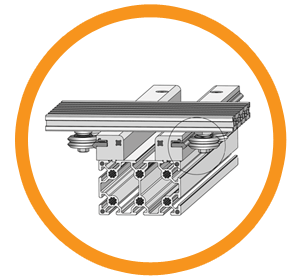
In today's game, we're asking you to match up the following terms with the appropriate images: cam follower, plain bearing, profile rail, and profile guide wheel.

[ DOWNLOAD ] the game and get started — good luck! You can check out other fun games like word search and crosswords for engineers on our website.

Friday, February 1, 2013

Top Five Tweets of the Week: STEM to STEAM, Bearings for Figure Skating, and California Job Losses


Rolling into 2013 with lots of exciting announcements about new engineering services and contract manufacturing offerings, we still have a keen eye on all things motion-related and that which inspires us through STEM initiatives (science, technology, engineering, and mathematics). But wait — have you heard the latest buzzword around STEM? What really caught our attention was topics related to "STEAM", which incorporates "art" into the acronym, is a movement championed by the Rhode Island School of Design (RISD) and adopted widely by institutions, corporations, and individuals.

www.bwc.com
1. STEM-to-STEAM: An Initiative That Brings Alludes that Technology Requires Creativity via www.stemtosteam.org: We're really excited about the objectives of this movement; Transform research policy to place Art + Design at the center of STEM, encourage integration of Art + Design in K-20 education, and influence employers to hire artists and designers to drive innovation. The website also says that STEAM was developed with the notion that technical know-how alone may not be enough to drive innovation, so as the United States marches further into the 21st century, institutions, companies, and other organizations alike are becoming, shall we say, more creative. In order to solve our nation’s current problems, an interdisciplinary, well-rounded approach that blends vital fields may be key.

2. California Loses 2,600 Manufacturing Jobs in December 2012 via www.cmta.org: In terms of manufacturing job growth, California did not finish the year out strong and did indeed continue to shed manufacturing jobs. In fact, according to 2001-2012 data, California manufacturing is declining 13% more than the U.S. In addition to that, California’s manufacturing base has eroded 32% since 2001 – a loss of over 600,000 manufacturing jobs that paid, on average, $20,000 a year more than service jobs.

3. Do Engineers Use Social Media? via www.element14.org: Yes, according to Calgavin, who reports that a whopping 61%, or over half of all engineers, use social media for work-related activities. According to their study, engineers use the following social media channels accordingly:
  • Google+: 33% 
  • LinkedIn: 43% 
  • Twitter: 22% 
  • Facebook: 67% 

And, their favorite types of content? Videos, articles, white papers, images, webinars, interviews, and forums!

4. Smart Manufacturing Will Rise to Global Challenges via www.controlglobal.com: Rockwell Automation’s CEO Keith Nosbusch has an interesting take on the future of manufacturing: "The coming decade will be the first in 200 years when emerging-market countries contribute more growth than the developed ones," says Nosbusch. He attributes this theory primarily to the high economic uncertainty within the United States, that is putting the brakes on current and future growth possibilities. Emerging markets, on the other hand, are developing to the point where increased manufacturing is needed, and may be able to occur in a much more cost-efficient, economically sound climate. Nosbusch attributed smart technology to 3 key drivers: technology, talent, and infrastructure.

www.about.com
5. Did you Know That Figure Skating Harnesses Use Ball Bearings? via www.about.com: Pulley systems, with harnesses, are used in figure skating to help ice skaters master jumps. These pulley systems utilize ball bearings and are of substantial strength in order to bear the weight of figure skaters of a variety of ages and sizes. The pulley system is operated by the coach or trainer, who helps hoist the skater into the area, and/or stabilizes their “in air” position to prolong a jump.

With that said, falling on hard surfaces can still make a skater prone to injury, so the more help a skater can get during his or her training, even in the form of jumping assistance, the better! Such equipment can be extremely useful to the skater who is trying to master his or her moves, reducing chances of hard falls.

THANKS — We hope you enjoyed this week's wrap up! Join us at @BWCnews for daily updates!

Thursday, January 17, 2013

#CoffeeChat: Stainless Steel Linear Slides with Brian Burke


SLIDING INTO PLACE The HepcoMotion® SL2 Stainless Steel Based Slide System is an adaptable addition to our range of linear rails, and offers the user with basic interchangeability with our line of GV3 linear guidance components such as stainless steel bearing assemblies, flat slides, spacer slides, etc. The SL2's complete corrosion resistance protects its linear motion bearings and ground stainless steel slides, which also comes with special surface treatment to beef up that corrosion resistance to meet U.S. Department of Agriculture standards for food processing applications.

We wanted to hear more about the SL2's capabilities, so we caught up with our [ Project Manager Brian Burke ] to pick his brain about this prominent part of our collection of guided motion technologies.

Q: How are SL2 rails similar or different from our GV3 product?
Brian Burke: The SL2 product line is a simplified subset offering of GV3 product made from stainless steel. The GV3 product line of linear guidance components is a diverse offering and includes a variety of linear guides with 70-degree vee edges, flat tracks, gear rack and pinions, carriage assemblies, guide wheels, cap wipers, accessories and components.

The GV3 linear guides are made of hardened 52100 carbon steel and are available in three grades of precision with bearings and track rollers also made from 52100 carbon steel. In the SL2 product line the most popular sizes and profiles from GV3 are available in 420C and 440C stainless steels and an additional offering is provided for assembled systems of carriage assemblies and tracks. At the core, SL2 is based upon flat tracks and double edge spacer slides made from 420C stainless steel with in the P1 precision grade with ground surfaces.

The SL2 product line does not include flat tracks or gear racks, but does offer carriage assemblies with stainless steel guide wheels and accessories such as aluminum flange clamps.

Question: How does the SL2 stand up in a wet, washdown environment? What about other types of harsh environments?
BB: SL2 can withstand moist environments much better than GV3 products because of the use of 420C and 440C stainless steel compared to the 52100 carbon steel. The 400 series of stainless steel is considered corrosion resistance steel, but can still oxidize and create rust. To improve corrosion resistance of 400 series steel, the spacer slides and flat tracks are fully ground to improve the surface finish. A ground surface has smaller bumps and cracks and much less surface area for the formation of oxidization. Therefore, the SL2 stainless steel tracks can withstand washdown environments better than GV3 products. Additionally, and screws, washers and fasteners are made from 300 series stainless steel.

Question: What materials are SL2 carriages comprised of? What's the benefit of each alloy?
BB: The carriage plates themselves are made from high strength aluminum and are surface treated for additional environmental compatibility. The guide wheels are made from 440C stainless steel with 300 series mounting studs and contain lithium based NLGI2 grease. These materials are more corrosion resistant that carbon steel alternatives found in GV3 products.

Question: Can SL2 rails be configured with any of our other product offerings? Which ones and in what scenario would you do that?
BB: SL2 is compatible with other GV3 products and can be combined or substituted if desired.  However, to maintain corrosion resistance of the entire assembly it would be best to stick to all SL2 products. Because the components are identical in form, and fit, alternates from GV3 can be utilized as is the case with cap wipers, track lubricators, and other accessories.


Question: What industries is the SL2 ideal for? What about food processing applications – what advantages does the rail bring to that industry specifically?
BB: SL2 can be utilized by any industry for applications where corrosion resistance is a concern. For the most part, SL2 is used in food production and packaging environments and clean room or low contamination environments. The corrosion resistance materials and surface preparations of SL2 make the product line well suited to applications in these industries.

Question: What's one of the most interesting SL2 application examples that comes to mind? Why did it work so well in that case?
BB: An interesting application for SL2 is pharmaceutical packaging operations where products are assembled into packaging and sealed for future use all inside a clean room environment.

[ To download a FREE catalog and CAD drawings, visit the SL2 product page ]

Monday, January 7, 2013

"Manufacturing Grows Our Economy" #MotionMonday


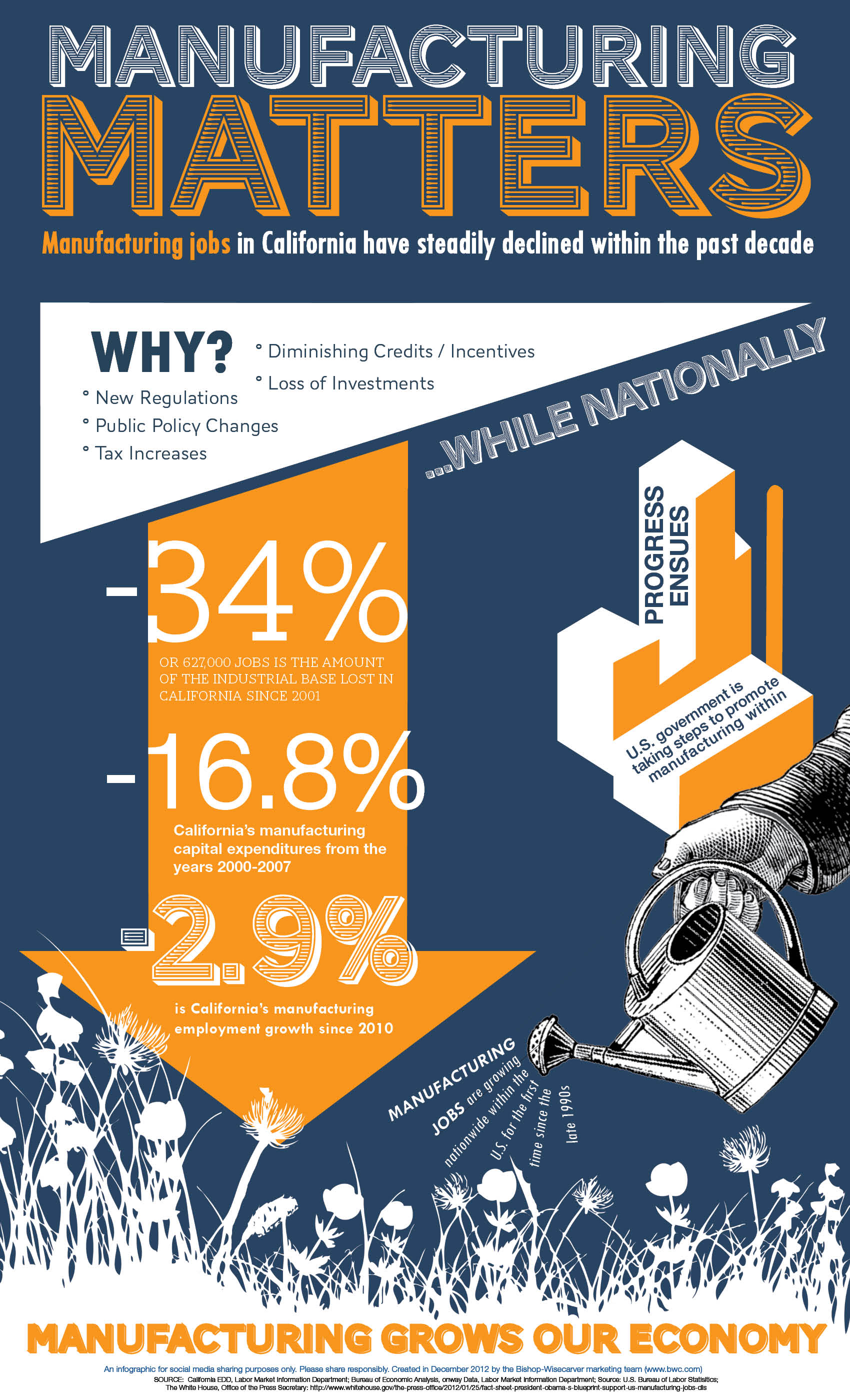
MANUFACTURING GROWTH — Since the early 2000s, California has seen a steady decline in manufacturing jobs — a loss of 79,000 between 2003 and 2007 alone, according to the California Manufacturing and Technology Association. Could heavy regulations be to blame? A report paid for by CMTA and released by the Milken Institute concludes exactly that, saying California's stringent rules force manufacturers to set up shop elsewhere.

Click here for the full image
During that same 2003-2007 time span when California shed massive amounts of manufacturing jobs, seven comparable states added some 62,000, the report continues. So how can California make itself more supportive of the industry that pays its workers an average annual salary of $66,000?

Part of what makes manufacturing in this state difficult is the quick changeover of labor laws, which makes it tough for companies to plan, the report says. Also, the fact that companies need approval from a complicated web of jurisdictions, which slows progress and could make a plan OK'd on the state level canceled by regional rules. Tax increases, investment losses and diminished credits and incentives add to the damage, the institute maintains.

If California had kept as many manufacturing jobs as it had in 2000, it would have seen 1.6 million more jobs and experienced $101 billion more in output by 2007, according to the report. That would translate into $75 billion more in wages than experienced in '07 and $5 billion more in income tax revenue. Obviously, the jobs exodus is nothing to sneeze at, and so the question remains: How to stop it?

STOPPING THE JOB DRAIN — Thankfully for the industry all about making things, some federal initiatives are in the works that aim to promote manufacturing across the nation. California manufacturing advocates are hoping it gives the Golden State an extra push to invest in its own companies.

President Obama unveiled a blueprint to promote domestic manufacturing and encourage companies to "insource" in lieu of "outsource".
  • First, the plan proposes removing tax deductions for outsourcing and add incentives to hire here at home. 
  • The incentive for insourcing would be targeted at companies that create jobs in the U.S. and the incentive would double for companies involved in advanced manufacturing.
  • Establish a tax credit for companies to invest in communities hit hard by the recession and job loss.
  • Provide temporary tax credits to green tech companies.
  • Reauthorize the right to expense any investment in plants and equipment.
  • Close loopholes that reward companies for investing abroad.
And there's more, but we'd like to turn the topic back to you. As a stakeholder in the manufacturing community, what's your assessment of the Milken report? What do you think of the presidential blueprint to support manufacturing as a nation? Do you think California can revive and sustain a thriving manufacturing sector by bringing jobs back home? Tell us in the comment box!