Showing posts with label linear guides. Show all posts

Friday, June 12, 2015

Guided Motion Solutions for the Prefab Home Industry

What comes to mind when you think of prefabricated homes? A mobile home park? Vinyl siding, steel roofs, monotonous rows of trailers or lackluster bungalows? 

Thanks to an unprecedented global uptake of prefabricated housing, the variety and quality of manufactured homes has expanded to include everything from the luxurious to low cost, from the aesthetically stunning to the spartan and practical. 


A high-end prefabricated home. (Image via iDesignArch)
Driven by a burgeoning interest in sustainable designs and a need for more affordable housing as real estate markets drive up the cost of living in most metropolitan job centers, prefabricated and modular homes are gaining renewed interest from consumers. In fact, prefab homes are becoming the most sought-after types of affordable housing, with cost savings realized through efficiencies in the manufacturing process instead of public subsidies. 

Japan and several northern European countries are leading the trend in off-site manufactured dwellings. In Sweden, some 84 percent of standalone homes use prefab wood elements, according to the Global Construction Review. 

Since 1976, KSM Log Homes has manufactured log home kits that are both aesthetically stunning and surprisingly cost-effective, given that the company is the mill, manufacturer, designer and shipper. Just take a look at the photos of KSM homes to see what we're talking about.

Some years ago, Bishop-Wisecarver Group came up with a custom solution to streamline mill operations at KSM. 


As part of an effort to improve automation, the log homes manufacturer developed and designed a machine that automatically mills notches in heavy logs used in prefab log homes. 


The machine needed to run up to 10 hours a day for five days a week. It needed bearings and tracks that could withstand being constantly bombarded with wood chips and sawdust. 

The answer? DualVee and Hepco assemblies. The unique vee-edge design of DualVee double-row angular contact ball bearings, which fling off debris, eliminated the need to cover the guidance system. DualVee bearings, one of our signature designs, not only withstand dirty and harsh industrial environments, they last for years without maintenance because of their self-cleaning design.

We love sharing application examples, to show how our guided motion solutions work for a diverse cross-section of industries, from heavy duty industrial plants to exacting medical and cleanroom settings. 

If you'd like to learn more about a specific product, let us know and we'll make it the subject of a blog post. Meanwhile, feel free to peruse our ever-growing library of application stories. 

Tuesday, May 19, 2015

10 Things You Should Know About STEM


Science, Technology, Engineering and Math—STEM, in colloquial parlance—are the tools we're using to build a better future. We like to think that the rock stars of the future will be robot-building, mechanically and scientifically inclined geeks. 
Manufacturing Day 2014 at Bishop-Wisecarver
That's why STEM is having something of a cultural moment right now. Everyone from celebrities to academics like Neil deGrasse Tyson, politicos to industry phenoms like Dean Kamen are promoting the sciences, trying to capture the imagination of young people and trying to get them to realize that STEM is becoming a shared language of the modern world. Those proficient in science, tech, engineering and math can be the leaders who shape our future. 

In that spirit of possibility, we present to you a list of 10 things you should know about STEM:

1. STEM shapes everything around us. Science is, essentially, our natural world. Technology gives us our phones, computers, telescopes and cars. Engineering begets bridges, appliances skyscrapers and the roads we drive on. Mathematics helps us budget, pay taxes and shed light on some profound truths about the nature of time, space and the universe. 

2. We have to get kids interested in STEM early on. STEM jobs are booming at a rate 1.7 times faster than for non-STEM jobs. But American schools aren't producing enough qualified candidates to keep pace. Only 16 percent of high school seniors expressed an interest in STEM careers, according to the U.S. Department of Education. 

Source: U.S. Department of Education

3. Not all STEM careers are created equal in terms of pay. The National Science Foundation tells us that women earn about half of all bachelor's degrees in STEM fields. But they tend to choose different concentrations than their male counterparts. Women generally focus on less-lucrative STEM fields, namely careers in health and life sciences, while men opt for computer science and engineering.

4. STEM skills translate to other fields. Seriously, if you speak "STEM," you're up for pretty much anything. In fact, some 74 percent of college grads with science and technical degrees pursue non-STEM jobs, per the U.S. Census Bureau. While that's kind of a bummer for STEM employers, it makes sense that other industries are recruiting scientifically inclined graduates—they can add value to any field. 

5. Early interest in science increases likelihood of a STEM career. The earlier you pique a kid's interest in STEM, the more likely he or she will stick it through to a career in a related field. This underscores the importance of early exposure to the sciences.

6. Native Americans have a significant interest in STEM. A survey by My College and STEMconnector found that Native Americans express more interest in STEM studies than any other ethnic group, except Asians. Abut one-third of Asian students and 30 percent of American Indian students say they plan to pursue a career in STEM. Yet, partly because of limited opportunities, Native Americans only make up 2.2 percent of all STEM students in the U.S.

7. STEM careers don't all require a four-year degree. There are a host of STEM jobs available for folks who opt for a two-year vocational program over a bachelor's degree. STEM jobs aren't limits to astronomers, physicists and engineers. According to the U.S. Bureau of Labor Statistics, STEM jobs include accountants working on financial modeling, investing, statisticians, machine shop workers and ancillary roles created by the manufacturing industry. Some of those occupations, like aerospace mechanics or construction managers, only require two-year post-secondary education. 

8. California is a leader in manufacturing. Maybe the Golden State conjures images of Hollywood and beaches, snowboarding and fine dining. But California is becoming increasingly known for  its technology and manufacturing. According to the U.S. Bureau of Labor Statistics, California, Texas, New York and Illinois will lead the nation in STEM careers by 2018. 

9. Americans need to brush up on math. Thirty-six percent of Americans admit they aren't fluent in math, according to a survey by STEM advocacy nonprofit Change the Equation. Among Americans aged 18 to 35, that figure ticks up to 53 percent. As a culture, we're much more comfortable with math illiteracy than language illiteracy. How many Americans do you think would admit they can't read, or can't read well? Maybe we should have a higher standard when it comes to numbers. 

10. Manufacturing pays well. The average manufacturing worker in the U.S. takes home $77,506 a year, including pay and benefits. Compare that to $62,546 for the average worker in all industries combined.

Monday, January 26, 2015

DualVee Vacuum Wheels Nominated for Golden Mousetrap Award

The Golden Mousetrap Awards recognizes technologies driving progress in the design and manufacturing field. The program, hosted by UBM Canon, awards companies contributing to the renaissance of American manufacturing and promotes engineering and manufacturing as viable career paths for the next generation.

That's why we're proud to announce that Bishop-Wisecarver was named a finalist in the annual Golden Moustrap Awards, for our DualVee Vacuum Wheels.

These vee wheels were designed specifically for vacuum environments and processing equipment where it's tough to use other guided motion products.

DualVee Vacuum Wheels are linear guide bearings with precision-ground 90-degree surfaces for applications in testing chambers and ultra-high vacuum environments.

It's a product suited for applications in research and development, package sealing, materials science, space testing and simulation and many other fields.

We put together a handy FAQ page about these new bearings here.

Here's a link to the Design News feature about the nomination.Winners of the Golden Mousetrap Awards will be announced Feb. 10 at the Anaheim Convention Center as part of ATX West. We look forward to being part of the action!

Tuesday, July 30, 2013

Manufacturing IS Technology


Gears, levers and other trappings of a steampunk contraption? Maybe you think of cartoon inventors like Maurice, Belle's father in Disney's Beauty and the Beast, with his coke-bottle goggles and bumbling attempts at various rudimentary forms of mechanical tinkering.
 
As manufacturers of linear slides and rotary guides, we know the importance of basic components, the bearings, gears and tracks that move things from one point to another. But these are only the building blocks for more advanced systems, which are poised to shape the future of the industry as well as the rest of the world.
3D printing technology is a manufacturing process
(photo credit: The Verge 2013)
 
It is likely that you have encountered or overheard some of the newer "buzzwords" that have been introduced to many laypersons, many of which were created in order to parboil complex cutting-edge innovations or indicate advancements beyond the cursory realm of simply "manufacturing". Today, you're more likely to hear words and phrases like "mechatronics", "advanced manufacturing", and "additive manufacturing", than simply, "manufacturing."


Maybe manufacturing has become a "dirty word," associated more with "dirty, dumb, boring [and] cheap" labor, as Bishop-Wisecarver Group CEO Pamela Kan poses in a post she wrote recently for GE's Ideas Laboratory. Perhaps the word "manufacturing" has become semantically outdated, which indeed justifies the industry's attempts to come up with contemporary lingo to more accurately describe the field in a way that makes sense.

When taken in accurate context, modern manufacturing is comprised of the latest and greatest innovations of our time. Surpassing the low-tech and common connotations of antiquity, modern manufacturing, both present and future, is high-tech: manufacturing is technology.

The Wall Street Journal published a piece last month that highlights this important definition. The article highlights the 11 areas of technology identified by the Advanced Manufacturing Partnership that will push manufacturing into the future. These emerging technological fields should be the focus of research and development in the U.S., the group says. So what are they?
  • Sensing, measurement, process control
    Manual processes: our past,
    but not our future?
  • Materials design, synthesis and processing
  • Digital manufacturing
  • Sustainable manufacturing
  • Nanomanufacturing
  • Flexible electronics manufacturing
  • Biomanufacturing
  • Additive manufacturing (better known as 3D printing)
  • Industrial robotics
  • Advanced forming and joining technologies
Kan mentioned before that it is a shame manufacturing has become a dirty word. However, with the exponential advancement of modern technologies (aka manufacturing), it's no problem to start making our language more specific to dispel whatever outdated notions the public still has about manufacturing being a thing of the early Industrial Revolution.

Changing the language can influence the national conversation in a way that encourages the next generation to choose careers in manufacturing and influences public policy to favor conditions that promote manufacturing innovation.


A number of emergent technologies
that apply to manufacturing


What do you think about the language we use to describe manufacturing? Tell us in the comments!

Friday, July 12, 2013

Top Five Tweets of the Week: Workplace Safety, Joys of Manufacturing and Mechanical Motion

Happy Friday, readers! We spent the week chatting about manufacturing news, engineering innovations and trends of a recovering economy. Here's a look at some of the people and topics that stuck out for us this time. Don't forget to follow us for future updates at @BWCnews!

1. Tips to Create an Accident-Free Work Environment via Creative Safety Supply: The biggest hit to production loss in a company are accidents, according to this blogger. If someone gets hurt, equipment gets damaged and processed ground to a screeching halt, everyone loses.
Here's a useful list of tips for how to avoid accidents in the first place. For starters: Train early, train often. A well-prepared workforce reacts smarter and clean up quicker. Link via @MikeWilsonCSS.

2. Teens Discover the Joys of Manufacturing via ABC Newspapers: Summer's here and that means, for those still in school, summer camp! Here's a recap of one such educational camp at Anoka Technical College for teens looking for more manufacturing know-how. Story via @AmericanControl.

3. Hydrogen-Powered Cars, Coming to a Highway Near You via Engineering.com: Typical counterparts to fossil fuel-powered cars are the hybrid and electric. But more auto-making giants are starting to invest in hydrogen fuel cell research. In fact, some hydrogen-powered cars may hit the consumer market by 2015. Story via @EngineeringCom.

4. Kinetic Great Sculpture Illustrates Concept of Mechanical Motion via Linear Motion Tips: As manufacturers of liner slides and rotary guides, we're obsessed with movement. Guided motion technology: That's what we do. So we got a kick out of Design World's post on this kinetic gear sculpture, a beautiful construction of moving parts. Post via @DesignWorld.

5. Q&A With Tom Chen, Applications Engineer via BWCnews.blogspot.com: We recently posted a blog about one of our engineers, Tom Chen, who holds more than 10 years of experience working with motion control, factory automation and laboratory automation. We'd like to thank Kyle at @ToyotaEquipment for re-sharing this post!

Wednesday, June 26, 2013

Manufacturing Still Makes America Strong

Photo credit: NAM
In 1895, as Americans struggled to stay afloat in the thick of the nation's worst recession to date, a group of business leaders met in Cincinnati, Ohio, to form the National Association of Manufacturers (NAM). They met to decide a course of action, to take charge of troubling economic circumstances by lobbying the powers that be on behalf of the manufacturing industry, as NAM Chair Doug Oberhelman explains in this video summary of the association's mission and history.

"Working together, they knew they could make a difference and chart a course for the future of manufacturing in America," NAM's current President and CEO Jim Simmons reiterated in front of an audience in March. Reminding them that the trade association has stood by manufacturers during times both good and bad, he named some examples:
When the first Model Ts rolled off the assembly line,
... when our industry helped the United States win both world wars,
…when farmers left their fields to enter the factory gates,
…when newly built tract homes helped families live the American dream,
…when technology and robotics transformed our businesses,
…and when global competition challenged America’s manufacturing dominance…
...during all of this, NAM has been the voice for manufacturers.

Today, NAM claims 12,000 members who represent another 12 million makers in the U.S., Bishop-Wisecarver among them. Our CEO Pamela Kan serves on NAM's Board of Directors. The goal that drew those manufacturing leaders together 118 years ago remains upheld today, only more urgently as manufacturing becomes an increasingly instrumental driver of our economic engine.

NAM's aim now, in addition to rallying for public policies that support manufacturing, is to educate the public about its importance and ever-evolving role in today's society. Kan wrote a few months ago about a faulty perception of manufacturing as dirty, dumb, boring and cheap in a much talked-about article titled "When Did Manufacturing Become a Dirty Word?"

Modern manufacturing is technologically sophisticated and a key driver of global R&D innovation, Kan notes. Bishop-Wisecarver Group has grown with the times, from engineering linear bearings and other motion control technologies to venturing into the world of mechatronics.

Plus, for anyone debating what career to pursue, realize this: it pays very well (click here for a look at the median salary for a mechanical engineer, for example).

"If you go back a century, it's almost impossible to see how we got from there to here," Oberhelman remarks in the video. "Computers didn't exist, there was no air travel, and gas-powered automobiles were still on the drawing board. What a fascinating story and even more astounding is the role manufacturing and the National Association of Manufacturers have played in revolutionizing our country."

Watch the video here:


Thursday, May 23, 2013

Double Product Feature: Paper Towel Transfer Unit & Spool Handling Unit


DOUBLE FEATURE Too much of a good thing is a very good thing, and in today's application spotlight, we're featuring two HepcoMotion products back-to-back. Check out how two different products were used for motion without limits.

TRANSFER UNIT FOR PAPER ROLLS
Twin back-to-back oval tracks have carriages joined with support rollers, with connecting links for driving, that move paper towels from one place to another. This assembly combines the PRT2 (precision ring and track) and DTS (driven track system) product lines.

SPOOL HANDLING UNIT
The durability and strength of HDLS (heavy duty driven linear system) lies in its capabilities. The beauty of HDLS is that it utilizes heavy duty slides and actuates them by AT series belt. Both the narrow unit and the wide HDLS units feature left, right, and dual
output shafts, and gear boxes may be supplied directly coupled to units. Extended output shafts on gear boxes are also possible to drive two systems in parallel.

Optional shock absorbers and rubber buffers are available for HDLS systems. In this application example the gripper holds a spool of kevlar fiber tape during the production of high performance composite storage tanks. The spool gripper rotates on a ring and moves on the HDLS unit.

To learn more about these application stories and
others, visit us online: bwc.com/app_stories.php

Wednesday, May 1, 2013

Q&A for Naasik Akkas, Test and Automation Engineer


Naasik first started at Bishop-Wisecarver
as an intern last year.
Naasik Akkas joined the Bishop-Wisecarver team late last year, bringing with him a mechanical engineering degree from UC Berkeley and with an internship at Bishop-Wisecarver already under his belt. Invigorated by the knowledge and experience that he was able to gain here during the summer of 2012, Naasik focuses his work on mechatronics as a Test and Automation Engineer. Not only was the team excited to have him the first time, but even more enthused that he came aboard after completing his education. Have a question for Naasik? Leave a comment in the comments section below!

Question: Why did you want to be an engineer, and did you always know that this was something that you wanted to do, or was it a decision that emerged later?

NA: My dad is a mechanical engineer and I saw what he got to do, so since I was very young I always thought I wanted to be a mechanical engineer. Once I was in high school I got really interested in physics and learned more about mechanical engineering, and that helped me decide that it was something I really wanted to do.

Question: Where did you receive your education in engineering and in what area did you specialize?

NA: I received a B.S. in mechanical engineering from UC Berkeley with an emphasis in controls and robotics. I ended up working on two sizeable projects: the first project was a robot that used computer vision to detect people and follow them around, and the second project was an amphibious vehicle that is able to travel on both land and water.

Question: What kind of job experience did you have before joining the Bishop-Wisecarver team?

Answer: I interned at Bishop-Wisecarver during the summer of 2012 doing job functions very similar to those that I am performing now. Before that, I had an internship in Bangladesh doing work with industrial automation.

Question: What advice would you give to a young person who is interested in a career in engineering? Let’s say a middle school student or a high school student.

Answer: Always try to improve your math and physics knowledge. Those are incredibly important subjects for a mechanical engineer to master. Also, for high school students I would say definitely go above and beyond the normal coursework. Most importantly, try to make real world connections with everything you learn.

Question: What's the most rewarding aspect of being an engineer?

NA: When something you build actually works.

Question: Technology plays a big role in the type of engineering that you do. Is it a lot of effort to stay abreast of recent technologies used in your area of expertise?

NA: It can be, but if you are always interested in the subject then it's easy to stay on top of it. I learn a lot from Ali Jabbari (Vice President of Engineering) and George Anwar (Consultant). So talking to the right people and being around the right people in the field helps. Also, articles on the internet and blogs that discuss technology are very useful.

Question: Which aspects of your role at Bishop-Wisecarver do you appreciate the most? In what areas do you find yourself working the hardest?

Answer: I appreciate the amount of creativity we are able to exercise with selecting components and also in other aspects of decision-making. I appreciate the ability to be able to make these types of decisions, and the level of responsibility that we are given is great because I get to learn more by being tasked with solving these problems.

Question: What’s your favorite quote, or personal motto?

Answer: “Victory is won not in miles but in inches. Win a little now, hold your ground, and later, win a little more.” — Louis L'Amour

Question: Do any of your hobbies outside of work relate to your job, any technical trades, or anything having to do with engineering?

Answer: I play with microcontrollers like the Arduino and the Lego NXT Robotics platform to build small devices and work on personal projects for fun. I like making home automation machines.

Question: Where do you see yourself in five years?

Answer: I want to see myself running my own industrial automation and robotics company.

Friday, April 26, 2013

Q&A With Mechatronics Engineer Garrett Diulio

Garrett Diulio working on a large
custom actuated linear guide (belt driven).
Garrett Diulio joined the Bishop-Wisecarver Group earlier this year, and with him comes great enthusiasm for all things mechatronic related. As our Mechatronics Engineer, Garrett is focused on projects that require both mechanical and electronic expertise. Have a question for Garret? Leave a comment in the section below!

Question: Why did you want to be an engineer, and did you always know that this was something that you wanted to do, or was it a decision that emerged later?

GD: For me, it was a decision that came later in life, during my first semester of community college. I liked math and science, and fixing things. I’ve always had fun building things and taking things apart and putting them back together.

I started out as an electrical engineer, and I realized shortly thereafter that my true passion was in mechanical engineering. It is so broad, probably the broadest field of engineering. You are exposed to everything. There is no job a mechanical engineer couldn’t do.

Question: What are your earliest memories of putting things together?

GD: I remember trying to take apart a cell phone as a little kid.

Question: Where did you receive your education in engineering, and in what area did you specialize?

GD: I received a degree from UC Berkeley and my major was mechanical engineering. I had to do a senior project that was very similar to what I’m doing here at BWG; my senior project was on mechatronics. Mechatronics is just a fancy word for a combination of electrical, software, mechanical, and controls engineering.

Question: What kind of job experience did you have before joining the Bishop-Wisecarver team?

GD: I had a few internships. I had one internship where I did a lot of mechanical design, which I do a lot of here as well, although the industry was different (the medical field). It was a company that made heart pumps and I had to design the connectors in CAD.

I had another internship as an analyst reviewing bone strength data, and I would use finite element analysis in order to find the varied strengths from patients; usually older patients. The software was used to predict when patients could potentially fracture their hip or pelvis… they recently got FDA-approved.

I did have a third internship that are similar to my duties at Bishop-Wisecarver. My responsibility for that job was to figure out how to make the robot navigate autonomously through a maze. I focused on software and the electrical portions of the project. This was preliminary research for a firefighting robot.

Question: What advice would you give to a young person who is interested in an engineering focused career? Let’s say a middle school student or a high school student.

GD: Make sure you are very passionate about the aspect of engineering you select — it really makes a difference in engineering. You can really tell a difference between people who come to work just to earn a paycheck and those who truly love what they do at the office. In engineering, it’s the little details that matter the most.

Question: What's the most rewarding aspect of being an engineer?

GD: Finishing a project — the point at which all elements are functional and operating the way they’re supposed to... that's a really satisfying feeling.

Question: Technology plays a big role in the type of engineering that you do. Does it require much effort to stay abreast of recent technologies used in your area of expertise?

GD: Going back to how passionate you are — if it’s what you love, it’s pretty easy to stay on top of it all. You’ll be willing and have the desire to keep learning, and it will come naturally to you; second nature almost. I think the key is always trying new things.

Question: Which aspects of your role at Bishop-Wisecarver do you appreciate the most?

GD: The thing that I must focus on the most is planning and scheduling; ordering due dates and logistics. It is always critical to make sure that everything comes together in the allotted time frame. Without planning and preparation, you are doomed.

Question: What’s your favorite quote, or personal motto?

GD: “The only way to do great work is to love what you do. If you haven’t found it yet, keep looking. Don’t settle.” – Steve Jobs

Question: Do any of your hobbies outside of work relate to your job — any technical trades or anything having to do with engineering?

GD: I still work on my senior project sometimes. It’s kind of a hobby. I still work on it because I want to showcase it someday. You think you’re close to perfection, but really, there’s always more to refine.

Question: Where do you see yourself in five years?

GD: Within five years, I hope to have created and launched my own product line based on the concept of autonomous machinery.

Tuesday, February 5, 2013

#CoffeeChat: QuickTrak, Fast Track Intro to Modular Linear Guides


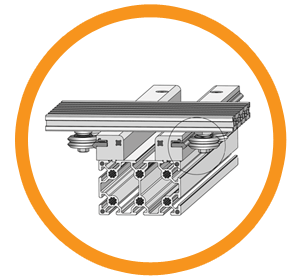
BACK ON TRACK The QuickTrak® modular based platform of linear guides and sub-assemblies was created to meet the needs of customers who required modification of existing machines — a quick, simple way to mount guidance systems. Think of it like an erector set for manufacturers, engineers and automation solution providers. These guides mount easily onto any beams with T-nut and T-slot-based kit of parts.

We sat down with one of our engineers, Leslie Lui, over coffee to discuss the possibilities of this particular type of motion solution. Here's what he had to say:

Why did we create this product? 
LL: QuickTrak was developed to aid machine builders seeking linear guidance solutions that offer flexible design and easy-to-assemble characteristics.

Most linear guide products require highly customized precision-machined components and mounting features in order to be integrated into an application. We made QuickTrak to cut the amount of time and work required for machine builders to design and build linear guide systems into their applications.

The QuickTrak product philosophy is about building linear guide systems from modular, cut-to-length and easy-to-piece-together parts instead of custom-designing the system and components from scratch.

Who benefits from using QuickTrak?
LL: QuickTrak benefits any machine builder who wants to quickly add a customized linear guidance system into their application with as little assembly and machining effort as possible.

How does QuickTrak help machine builders?
LL: QuickTrak support assemblies permit DualVee® track to be easily mounted to applications without the need for careful machining and preparation of any mounting substrates. QuickTrak single-edge and double-edge track supports can be mounted onto standard T-slot extrusions with readily available fasteners and do not require any mounting substrate machining. QuickTrak double-edge track supports can also be mounted to most flat surfaces, requiring only the machining of suitable mounting holes.

QuickTrak wheel plate assemblies are composed of specialized sets of wheel and brake components fastened onto custom profile T-slot extrusion wheel plates. QuickTrak wheel plate assemblies are designed to be put together with simple hand tools.

The T-slots serve as mounting features for both the customer payload and wheel plate assembly components. The T-slots span the entire width of the wheel plate, providing far more mounting possibilities for customers than individual mounting holes. The width of the wheel plate can be quickly and easily sized to match customer-determined track support spans and accommodate specific extruded stock. Optional brake sub-assemblies permit wheel plate assemblies to be quickly locked in any desired position on their track support assemblies.

[ Click here ] to download free CAD drawings, catalogs, and data sheets about QuickTrak

Thursday, January 17, 2013

#CoffeeChat: Stainless Steel Linear Slides with Brian Burke


SLIDING INTO PLACE The HepcoMotion® SL2 Stainless Steel Based Slide System is an adaptable addition to our range of linear rails, and offers the user with basic interchangeability with our line of GV3 linear guidance components such as stainless steel bearing assemblies, flat slides, spacer slides, etc. The SL2's complete corrosion resistance protects its linear motion bearings and ground stainless steel slides, which also comes with special surface treatment to beef up that corrosion resistance to meet U.S. Department of Agriculture standards for food processing applications.

We wanted to hear more about the SL2's capabilities, so we caught up with our [ Project Manager Brian Burke ] to pick his brain about this prominent part of our collection of guided motion technologies.

Q: How are SL2 rails similar or different from our GV3 product?
Brian Burke: The SL2 product line is a simplified subset offering of GV3 product made from stainless steel. The GV3 product line of linear guidance components is a diverse offering and includes a variety of linear guides with 70-degree vee edges, flat tracks, gear rack and pinions, carriage assemblies, guide wheels, cap wipers, accessories and components.

The GV3 linear guides are made of hardened 52100 carbon steel and are available in three grades of precision with bearings and track rollers also made from 52100 carbon steel. In the SL2 product line the most popular sizes and profiles from GV3 are available in 420C and 440C stainless steels and an additional offering is provided for assembled systems of carriage assemblies and tracks. At the core, SL2 is based upon flat tracks and double edge spacer slides made from 420C stainless steel with in the P1 precision grade with ground surfaces.

The SL2 product line does not include flat tracks or gear racks, but does offer carriage assemblies with stainless steel guide wheels and accessories such as aluminum flange clamps.

Question: How does the SL2 stand up in a wet, washdown environment? What about other types of harsh environments?
BB: SL2 can withstand moist environments much better than GV3 products because of the use of 420C and 440C stainless steel compared to the 52100 carbon steel. The 400 series of stainless steel is considered corrosion resistance steel, but can still oxidize and create rust. To improve corrosion resistance of 400 series steel, the spacer slides and flat tracks are fully ground to improve the surface finish. A ground surface has smaller bumps and cracks and much less surface area for the formation of oxidization. Therefore, the SL2 stainless steel tracks can withstand washdown environments better than GV3 products. Additionally, and screws, washers and fasteners are made from 300 series stainless steel.

Question: What materials are SL2 carriages comprised of? What's the benefit of each alloy?
BB: The carriage plates themselves are made from high strength aluminum and are surface treated for additional environmental compatibility. The guide wheels are made from 440C stainless steel with 300 series mounting studs and contain lithium based NLGI2 grease. These materials are more corrosion resistant that carbon steel alternatives found in GV3 products.

Question: Can SL2 rails be configured with any of our other product offerings? Which ones and in what scenario would you do that?
BB: SL2 is compatible with other GV3 products and can be combined or substituted if desired.  However, to maintain corrosion resistance of the entire assembly it would be best to stick to all SL2 products. Because the components are identical in form, and fit, alternates from GV3 can be utilized as is the case with cap wipers, track lubricators, and other accessories.


Question: What industries is the SL2 ideal for? What about food processing applications – what advantages does the rail bring to that industry specifically?
BB: SL2 can be utilized by any industry for applications where corrosion resistance is a concern. For the most part, SL2 is used in food production and packaging environments and clean room or low contamination environments. The corrosion resistance materials and surface preparations of SL2 make the product line well suited to applications in these industries.

Question: What's one of the most interesting SL2 application examples that comes to mind? Why did it work so well in that case?
BB: An interesting application for SL2 is pharmaceutical packaging operations where products are assembled into packaging and sealed for future use all inside a clean room environment.

[ To download a FREE catalog and CAD drawings, visit the SL2 product page ]

Friday, December 21, 2012

Top Five Twitter Posts: Force of Manufacturing, Solar Panel Stickers and an Engineering Hero


Smack-dab in the middle of the holidays and we're still busy as ever in cyberspace and on the manufacturing floor, making conversation online and guided motion solutions at our Bay Area headquarters. It's an exciting time of year. Let us fill you in on some of the chatter that defined our Twitter conversations this week, from the funny to the fascinating. Make sure to follow our future tweets at @BWCnews!

Credit: Motion System Design
1. The Force of U.S. Manufacturing in Motion System Design magazine: The glossy publication put together a nice piece on the "new normal" of global manufacturing and the role domestic industry plays in the field's worldwide growth. On the panel cited in this article is BWC's very own Pamela Kan, CEO member of various public advisory panels. In it, Kan talks about, among other things, the importance of manufacturing products in the U.S., the meaning of productivity and how we can improve domestic manufacturing.

2. Peel-and-Stick Solar Panels via Product Design & Development Magazine: For the first time, scientists have found a way to create flexible solar cells, bendable enough to fashion into peel-and-stick patches. The developing vastly widens the application of solar technology, the magazine says. We've achieve "the ideal: flexible, decal-like solar panels that can be peeled off like Band-Aids and stuck to virtually any surface, from papers to window panes."

3. Boeing, BMW Join Forces on Manufacturing Executive Blog: Recent advances of new composite materials, namely carbon fiber, to build super lightweight cars and aircraft has led BMW and airline giant Boeing. We look forward to seeing the innovation the partnership will breed!

Credit: Big Beacon
4. The Jackhammer Elegies: A Novel with an Engineering Hero via Big Beacon: A few blogs posts ago, we suggested some pretty cool gift ideas for engineers. But here's another we'd like to retroactively add to the list. It's a book whose protagonist, Scott Carter, is a civil/structural engineer. Click through to read more about the novel in an interview with its author, Stefan Jaeger.

5. Skills Gap to Drive Manufacturing Power Shift via Manufacturing Engineering Media: While we talk about reshoring manufacturing and repatriating domestic profits, here's a piece that reminds us how a shortage of skilled laborers will keep pushing manufacturing overseas unless the U.S. comes up with a policy to counteract that. Do you think we'll see a formal U.S. manufacturing policy in 2013?

Monday, December 17, 2012

#MotionMonday: Gearing Up For the FIRST Robotics Kick-Off


STEM SUPPORTERS —
As strong supporters of STEM initiatives, we are always looking for opportunities where we can encourage our local science, technology, engineering and math students to do great things. One of the many ways we reach out to students is through FIRST, an annual robotics competition founded by Dean Kamen. During the 2013 program we are sponsoring three high school teams as Diamond Suppliers to the kit of parts — The Vacaville Robodogs, the Sacramento Fembots and the Brentwood Patriots.

Look for us in the 2013 program catalog
READY TO RUMBLE? — These teams will take part in a national contest that pits robots they design and build against those of other teams. FIRST robotics, the nonprofit organization that facilitates the months-long competition, aims to promote STEM education and foster future engineers and scientists by making STEM education fun and practical. We contribute guided motion components, financial aid and publicity to support some of our local teams.

This year's FRC kick-off takes place on Saturday January 5, 2013. We'll be covering the event at San Jose State University, where hundreds of students will compete in what marks the start of the design and build season. At the kick-off event students will, "compare notes, get ideas, make friends, find mentoring teams, learn the game, pick up the Kit of Parts and get geared up for the exciting competition seasons." (Credit: USFIRST.org).

VARSITY SPORT FOR THE MIND — The FRC season culminates in an intense competitive event that draws teams from all over the world to compete in large arenas in a competition that requires students' robots to achieve complex tasks. What makes the competition so fierce is that FIRST culls the best and brightest young minds to compete, and then there are the variables on game day: Will the battery run out? Will the machine malfunction? How to tackle those problems on game day while the clock keeps ticking?

The program teaches kids to think on their feet and dream up innovative solutions to immediate problems. That ingenuity lies at the heart of invention and engineering, it provides the foundation for a robust manufacturing sector because it fuels innovation. That's the spirit we aim to foster here. And that's why we support FIRST.

Monday, December 10, 2012

Gift Ideas for Engineers, Builders, DIY Makers


Have you finished all that holiday shopping for the engineer in your life? If not, here's our top five picks so far. In this Motion Monday edition we're featuring some of the coolest gadgets and trinkets shared with us on our social media channels — from the good and the great on ThinkGeek.com to all things found on Amazon.com. What sort of engineering fun did you find online this year?

1. Desktop Gear Clock: Got gears? It's a timepiece built out of a bunch of gears in various sizes, and we found it for a few dollars shy of $50 on Amazon.com — a great visual!

Credit: Amazon.com
2. Piston Mug: Need a gift for a mechanical engineer in your acquaintance? How about a handy coffee mug shaped like a piston? It's chrome-plated, dishwasher safe (but not microwaveable) and insulated to keep your favorite beverages hot or cold. And oh, Amazon, it's so hard to beat your prices ... we found one for $19.99 on the retail giant's online store.

3. Level Cufflinks: How about present that is stylish and practical? Check out these cuff links that double as level. The familiar neon liquid is bound to be appreciated by anyone with experience building things. Click through to find these cuff links offered by CuffCrazy for $30.

4. Ultimate 5-in-1 Pen: "The pen that makes all other pens quiver in inadequacy" — an amazing claim from our friends at Think Geek, right? Hyperbolic as it may seem, you can't help but be impressed the five geek tools crammed into one apparatus. You have a pen, stylus, LED flashlight and red laser pointer all in one convenient pen. Even more impressive? It's less than $10.

Credit: ThinkGeek.com
5. Pizza "Pi" Cutter: "Cut your pie with Pi," suggests Think Geek. "For such an irrational number, you sure are kind. You help us do all sorts of things — like figure out the area and circumference of our pizza. And now, with the power of future technologies, and combining things with other things, you will also be able to cut our pizza into pieces." We couldn't have said it better ourselves. If you you know a pizza lover who also appreciates the power of Pi, it's likely well worth the $15 to order them this cleverly make cooking utensil.

Thursday, December 6, 2012

Watch, Read, Listen, Do: Engineering Roundtable, Re-shoring Manufacturing and Free Application Stories


Part of what encourages a forward-thinking and innovative culture is how well a business keep tabs on current events, new ideas and the trajectory of modern manufacturing. Every day we scourer social media channels for the good and the great — we're more than just your linear guide manufacturer! Here's a bit of what caught our interest in the world of science  manufacturing, engineering and technology.

Where do you dial in for the latest news?

[ WATCH ] The crew at Design World network held an editorial round table again, another installment in their new series in which the newsroom staff speaks with industry experts on a variety of engineering-related topics. Check it out and stay tuned for future episodes. Great idea, guys!

[ READ ] James Fallows writes in a recent Atlantic article, "For decades, every trend in manufacturing favored the developing world and worked against the United States. But new tools that greatly speed up development from idea to finished product encourage start-up companies to locate here, not in Asia. Could global trade winds finally be blowing toward America again?" What do you think?

[ LISTEN ] Did you know that the National Academy of Engineering has an online archive of audio podcasts related to the field? And they're free too, so tune in!

[ DO ] Designers, engineers and all-around thinkers and makers draw inspiration from many places in the world including from each other. That's why we're so fascinated by application stories — they tell us how someone else solved a solution that may be common to other people. Seeing how other people approach a problem can help us engineer a more refined solution as well. In that spirit of sharing and inspiration, we invite you to peruse our library of application examples and to download any number of them for free! These case studies examine applications in industries such as industrial machinery, medical device manufacturing, transportation, robotics and many more.

Monday, November 19, 2012

#MotionMonday: Is Manufacturing Dead? Far From It, NAM Says


AN INDUSTRY RENAISSANCE – Companies who make things are what drives a country's economy. It's production that generates jobs and galvanizes the economy so that policymakers can drive down the national debt. Since so much rests on the fate of manufacturing in the United States, lots of ink has been spilled and airtime spent on the subject this year. NBC's Rock Center with Brian Williams ran a special earlier this month that addressed what it called a manufacturing renaissance in domestic manufacturing.

"The United States may have shifted to a postindustrial economy," the report begins, "but that does not mean the manufacturing sector is dead. Far from it."

A definite revival is underway, and although we need it, do we have the skilled workforce to take this on?

"From coast to coast, manufacturers are making more products, but with fewer people, as the sector makes an improbable rebound right after a tough recession."

MANUFACTURING HOPE FOR THE FUTURE – The National Association of Manufacturers, NAM, is very passionate about this topic. Chairwoman Mary Andringa also appeared on William's show to talk about the bright future of our industry sector.

"I think it's a time of great opportunity in manufacturing," she tells Williams before enumerating some reasons why. She points out:
  • The U.S. output $4.8 trillion of manufactured goods in 2010, up from $4.1 trillion in 2000
  • That growth came despite the nation going through two recessions in a decade
  • The U.S. remains in the lead by producing 21 percent of the world's manufactured goods, followed by China and Japan
Manufacturing also remains a bright spot in our economic recovery," NAM writes on a recent blog post, "fighting against unprecedented headwinds to hire skilled workers and invest in high tech facilities."

[ NAM published a guide to this manufacturing renaissance here, FREE to download! ]

"There's a renaissance going on," Andringa says.

CHANGES AHEAD – The story reports that it's obvious manufacturing has changed, evolving to become more high-tech. It's grown up in a lot of ways, NAM says, reworking itself to become cleaner, more efficient, more in line with principles of lean manufacturing. And increasingly, it's become a sector on which the public pins a lot of potential, a lot of hope for a better tomorrow.

Monday, November 5, 2012

Will Crowdsourcing Expedite the Manufacturing Process? #MotionMonday


WORKING TOGETHER — In the 19th Century, Professor James Murray struck up a literary project that required tens of thousands of volunteers to help him complete. His mailbox got bombarded with six million letters over the next several years from strangers documenting the definitions and origins of virtually every English word. It took seven decades to finish the first Oxford English Dictionary, the first crowdsourced collection of knowledge in known history.

Since that first manifestation of crowdsourcing, years before the term was coined by Jeff Howe in a June 2006 Wired magazine article, companies, government agencies and other entities have reverted to crowdsourcing to gather new ideas.

MANUFACTURING CHANGE — Could the crowdsourcing model fast-forward innovation in the manufacturing sector? The Pentagon thinks so. Earlier this year, the agency responsible for military funding created a crowdsourcing effort called the Defense Advanced Research Projects Agency, which aims to slash the design-to-production cycle by two to four years through offering prize incentives for design ideas, according to a New York Times article published in April. Since researching, developing and building U.S. military assets is a famously time-consuming and pricey ordeal, it normally takes anywhere from a decade or two to manufacture a new tank, the article says.

The defense research project will use a software platform called VehicleFORGE, a portal for the exchange of ideas. The online format makes sense, considering that crowdsourcing is nothing new to the software industry. Crowdsourcing is what spawned programs like Linux and Apache.

What's unique about this recent military effort to crowdsource vehicle design is how well it fits into other fields of manufacturing. An M.I.T. professor explains to the New York Times:


Teaming up with academic institutions could expand crowdsourcing possibilities even more. How much R&D time do you think a submission like that would save the pentagon? Or even a private company? Think of how much more can be accomplished if many more minds could tackle a project together.

"Sometimes the best and brightest ideas come from the most unlikely or unheralded sources," Associate Editor Mike Schmidt wrote for Manufacturing.net a couple months ago.

WHAT DO YOU THINK?  —  How could the practice of crowdsourcing change manufacturing? The good and the bad? Some commentators tout the practice as the "Holy Grail" of innovation, but what are some of the risks? Do the risks outweigh the benefits of diversifying your company's talent pool?