Showing posts with label coffee chat. Show all posts

Thursday, January 17, 2013

#CoffeeChat: Stainless Steel Linear Slides with Brian Burke


SLIDING INTO PLACE The HepcoMotion® SL2 Stainless Steel Based Slide System is an adaptable addition to our range of linear rails, and offers the user with basic interchangeability with our line of GV3 linear guidance components such as stainless steel bearing assemblies, flat slides, spacer slides, etc. The SL2's complete corrosion resistance protects its linear motion bearings and ground stainless steel slides, which also comes with special surface treatment to beef up that corrosion resistance to meet U.S. Department of Agriculture standards for food processing applications.

We wanted to hear more about the SL2's capabilities, so we caught up with our [ Project Manager Brian Burke ] to pick his brain about this prominent part of our collection of guided motion technologies.

Q: How are SL2 rails similar or different from our GV3 product?
Brian Burke: The SL2 product line is a simplified subset offering of GV3 product made from stainless steel. The GV3 product line of linear guidance components is a diverse offering and includes a variety of linear guides with 70-degree vee edges, flat tracks, gear rack and pinions, carriage assemblies, guide wheels, cap wipers, accessories and components.

The GV3 linear guides are made of hardened 52100 carbon steel and are available in three grades of precision with bearings and track rollers also made from 52100 carbon steel. In the SL2 product line the most popular sizes and profiles from GV3 are available in 420C and 440C stainless steels and an additional offering is provided for assembled systems of carriage assemblies and tracks. At the core, SL2 is based upon flat tracks and double edge spacer slides made from 420C stainless steel with in the P1 precision grade with ground surfaces.

The SL2 product line does not include flat tracks or gear racks, but does offer carriage assemblies with stainless steel guide wheels and accessories such as aluminum flange clamps.

Question: How does the SL2 stand up in a wet, washdown environment? What about other types of harsh environments?
BB: SL2 can withstand moist environments much better than GV3 products because of the use of 420C and 440C stainless steel compared to the 52100 carbon steel. The 400 series of stainless steel is considered corrosion resistance steel, but can still oxidize and create rust. To improve corrosion resistance of 400 series steel, the spacer slides and flat tracks are fully ground to improve the surface finish. A ground surface has smaller bumps and cracks and much less surface area for the formation of oxidization. Therefore, the SL2 stainless steel tracks can withstand washdown environments better than GV3 products. Additionally, and screws, washers and fasteners are made from 300 series stainless steel.

Question: What materials are SL2 carriages comprised of? What's the benefit of each alloy?
BB: The carriage plates themselves are made from high strength aluminum and are surface treated for additional environmental compatibility. The guide wheels are made from 440C stainless steel with 300 series mounting studs and contain lithium based NLGI2 grease. These materials are more corrosion resistant that carbon steel alternatives found in GV3 products.

Question: Can SL2 rails be configured with any of our other product offerings? Which ones and in what scenario would you do that?
BB: SL2 is compatible with other GV3 products and can be combined or substituted if desired.  However, to maintain corrosion resistance of the entire assembly it would be best to stick to all SL2 products. Because the components are identical in form, and fit, alternates from GV3 can be utilized as is the case with cap wipers, track lubricators, and other accessories.


Question: What industries is the SL2 ideal for? What about food processing applications – what advantages does the rail bring to that industry specifically?
BB: SL2 can be utilized by any industry for applications where corrosion resistance is a concern. For the most part, SL2 is used in food production and packaging environments and clean room or low contamination environments. The corrosion resistance materials and surface preparations of SL2 make the product line well suited to applications in these industries.

Question: What's one of the most interesting SL2 application examples that comes to mind? Why did it work so well in that case?
BB: An interesting application for SL2 is pharmaceutical packaging operations where products are assembled into packaging and sealed for future use all inside a clean room environment.

[ To download a FREE catalog and CAD drawings, visit the SL2 product page ]

Tuesday, October 9, 2012

Explore the Guided Motion Possibilities of Linear Bearings with Applications Engineer Dan Fletcher, Coffee Chat Part III of III


ROLLING RIGHT ALONG Today, we're wrapping up our ongoing conversation about DualVee Motion Technology with one of our Applications Engineers, Dan Fletcher. Click here to read Part I about precision and speed, or Part II about tolerances and lubrication.

Have questions for Dan about this coffee chat series? Send him an email at danf@bwc.com!

SIZING TIPS DualVee guide wheels come in a range of diameters to support different load specs. For example, a single 75 mm 4XXL double-vee wheel can hold radial loads of 3,215 lbf. A single 150 mm vee bearing wheel has a radial load capacity of as much as 11,240 lbf while a four-wheel carriage can handle double that.

What do you need to consider when calculating load evaluations?
Dan: Evaluating guide wheel loads is relatively easy, but it is important to clearly understand the conditions under which they will be used. Start with determining whether the loads are radial or axial (see image).

What factors affect the service life of guide wheel systems?
Dan: Several factors influence the service life of guide wheel systems such as size of the bearing elements, relative spacing, and the orientation, location and magnitude of the load. There's a simple method you can use that will estimate the load/life relationship by defining the loading conditions. The equations (below) are based on clean and well-lubricated track conditions. The ratings and calculations are theoretical values based on ideal conditions. Most  applications will involve less than fully optimum conditions, and in a situation where a particular size bearing may appear marginal in capacity, selection of the next larger bearing size is recommended.

How do you calculate load/life relationships?
Dan: To start, you have to understand three things: The principles of statics, the ability to use free-body diagrams, and the know-how to resolve externally applied forces on a carriage assembly into the axial and radial reaction forces at each linear guide wheel. The most heavily loaded bearing in the design will determine the life of the guide wheel system.

What steps go into sizing and choosing a guide wheel assembly?
Dan: That can be done in three steps. This includes figuring out the radial and axial loads, how much weight is applied to the most heavily loaded bearing, and applying those variables to make up for speed, environment, shock, and vibration.

[ FREE DOWNLOAD ] White Paper: Guide Wheel System Properties, Selection & Sizing

Is all of this difficult to do?
Dan: Only a simple understanding of engineering principles and force analysis is needed to properly evaluate and size these types of systems.

Thursday, October 4, 2012

Explore the Guided Motion Possibilities of Linear Bearings with Applications Engineer Dan Fletcher, Coffee Chat Part II of III


[ This is Part II of a three-part series on guided motion basics — read Part I here ]

TOLERANCES AND LUBRICATION 
We're picking up from yesterday's conversation about the form, function and range of environments that DualVee Motion Technology® is built to handle. Today, we'd like to talk about the tolerances and lubrication of the double row angular contact bearing. We continue the series with one of our Applications Engineers, Dan Fletcher.

Tell us about DualVee's tolerances — what are the contact bearing's basic capabilities?
Dan: Most of the time, an off-the-shelf guide wheel system should meet positioning tolerances of +/-0.005 inches, depending on the surface. If the track is hardened and ground to specific tolerances, the bearing could then meet positioning tolerances of +/-0.001 inches.

More often than not, double row angular contact bearing designs rely on the track's base mounting surface to maintain accuracies and tolerances. If the mounting is stiffer than the track, the track will adapt to the flatness, straightness, parallelism and twist — if designed with that in mind. If the design doesn't need to be that precise, the mounting surfaces don't have to be as demanding, which lessens the overall cost of the project.


Can you elaborate? 
Dan: Well, for example, if the application needs tolerances of +/-0.004 inches, you can bolt a guide wheel system to a sort-of uneven surface and a carriage will still work and run smoothly. Time spent on preparing the surface is minimal, though, and so is the cost and time spent to install it. But if you need +/-0.001 inches for an application, that just means spending more time to prepare the mounting surface, which raises the price.

Why is lubrication important?
Dan: As with many bearing systems, proper lubrication will enhance service and product life.

What if lubrication isn't a requirement for an application? 
Dan: If that's the case, the guide wheels are still often a preference over alternative motion technologies. Lots of cleanroom applications in the medical industry demand dry rollers to cut out possibility of contamination, to cite one example.

[ Join us next week for the final installment in this series, where we talk about DualVee Sizing Tips ]

Wednesday, October 3, 2012

Explore the Guided Motion Possibilities of Linear Bearings with Applications Engineer Dan Fletcher, Coffee Chat Part I of III


PRECISION AND SPEED These two factors are critical when spec'ing what linear guide system works best for your application. Many other variables must be considered as well, such as environment type, duty cycle, length, temperature and payload weight. To help explain how to choose the right guide wheel system for you, we turned to one of our applications engineers, Dan Fletcher.


What makes the DualVee® wheel stand out from other linear motion technologies? 
Dan: In each of the three major linear motion technologies (profile rails, round rails, and guide wheels), ball bearings recirculate. In profile and round rails, however, the bearings ride on the guide rail and are exposed to any of the contaminants that may settle on the rail. The bearings in a 90° double-vee guide wheel are self-contained and isolated from the environment, so there is no contact between the bearings and the rail.

Why is the actual shape and form of the wheel important?
Dan: Most contaminants that settle on vee guide rails are swept away when the wheel passes over the rail. When the wheel spins at a constant speed, the diameter at the inner vee travels at a slower rate than the diameter at the outer vee, causing a velocity gradient that pushes the debris outward.

How did DualVee Motion Technology come about?
Dan: The double-vee design was originally developed in 1967 as a replacement for flat rollers on machinery at a fertilizer packaging plant, where debris from the processing operations continuously clogged the bearings, causing equipment to shut down. The 90° double-vee approach, with its inherent wiping action, proved ideal.

What are some other advantages of choosing a DualVee-based linear motion system? 
Dan: Those self-contained ball circuits have other, lesser-known advantages, too. The containment can cut noise levels by up to 20 percent in some applications compared to alternative re-circulating technologies. The DualVee runs smoothly for several reasons. For one, it has a constant radius ball bearing path. Its carbon, stainless steel and composite components also contribute to its effortless movement.

What about noise? 
Dan: The steel versions are slightly louder, but permit fast acceleration, up to 5 gs, and speeds up to 5.5 m/s. For quieter motion, and a more economical option, the polymer versions works well in chemical-exposed settings and lighter-load applications.

[ Read about DualVee's tolerances and lubrication requirements in Part II—tomorrow! ]

Monday, March 26, 2012

Coffee Chat: Join the Chain [ Actuation ] Gang


KEEPING A LOW PROFILE LoPro is our signature product line of linear actuators based on DualVee Motion Technology — pre-engineered units we launched in the mid-1990s in response to an increasing demand from our customers looking for long-length actuation. It's a super versatile linear motion solution that comes in custom lengths and a variety of actuation types. Namely, chain, lead screw, ball screw and belt drives.

For today's coffee chat, we wanted to focus on chain actuation — an option that makes us stand out in the industry because it's not widely offered in the linear motion market, according to our Project Engineer Brian Burke. Why chain actuators are not more commonly offered is a good question, but in this edition we've focus on the pros and cons of chain actuation, how it works and for what applications it works best.


PRODUCT OF ENVIRONMENT One main challenge for any actuator is how it stands up to contaminants, whether small and soft or large and gritty, aluminum chips or sawdust, Burke said. Some actuators grind to a halt when debris builds up in the guide and drive systems. The chain changes all that.

"LoPro is especially well suited for reliable operation in these extremely contaminated environments when configured with the chain drive option," Burke said.

Chain and sprocket drives work excellently in very dirty environments because the sprocket teeth fling away debris from the chain gaps, he explained. If contaminants start to build up at the sprockets inside the drive and idler ends, however, the chain can start conveying that debris. To make sure it doesn't, LoPro units come with an open bottom drive and idler ends to let the particles just fall through instead of accumulating.

SIZING IT UP All five LoPro sizes can come with chain actuation, Burke said, although lot of times, people choose the chain-drive actuators to hoist huge loads or carry them across pretty long lengths. From the roller chain #25 on the smallest through the #50 on our largest unit — all of which come with either carbon steel or corrosion-resistant stainless steel chain, sprockets, fasteners and bearings.

Since LoPro units are basically heavier duty when outfitted with chain actuation, they're normally manufactured in lengths that surpass the capability of ball screw-driven actuators, Burke said. By the way, remember that [ infographic we made that compared ball and lead screw actuation ]?

Ball screw actuators don't normally travel more than 96 inches, which for a chain-actuated drive, that length isn't an issue at all. But if the required travel length is longer than that, say around 600 inches, the best bet isn't chain but an AT belt drive, Burke said. If it's that long, the chain starts to drag inside the LoPro when positioned horizontally. Since chain is high-tensile, it works well for vertical applications, like lifting, he said. At least that way, the chain won't sag.


THE CONS Of course, there is a downside to every option — it's all a question of application requirements. For one thing, the metal-on-metal friction between drive sprockets and chain means it needs lots of lubrication to prevent wear and tear and eventual failure. The metallic grinding also means chain-driven rails get pretty noisy compared to other drive options.

Chain also gets stretched out over its usable life, Burke said. So it has to be adjusted after its first use and then periodically to make sure it performs well. And though they're great if moving in one direction, chain drives get a lot of backlash if they're bi-directional. Backlash means less linear accuracy compared to other drive options.

CIRCLING BACK AROUND LoPro units driven by chain actuation have many advantages over other drive options, Burke said, especially for dirty environments and long travel lengths. With enough maintenance and lubrication, chain drives can perform well for years. They're not meant for highly accurate applications because of possible stretching and the backlash, but they're great for vertical lifting functions. As we said earlier, it's all a matter of application specifics.


MOTION MONDAY CHALLENGE Since it's #MotionMonday, we're turning this into a game. This time, since we got a little wordy, we've concocted a crossword challenge to test your reading retention. The first 10 people to email the correctly answered puzzle will get some fancy BWC swag. You ready for this? Let's go!

[ Download the puzzle here ]

Friday, February 24, 2012

Linear Guide Wheels and Track for Woodworking


When you're sawing, drilling or carving wood, chips and debris are gonna fly. That's why a self-cleaning motion system is a must. A story in this month's issue of Custom Woodworking Business magazine about the latest woodworking technologies, namely computer-programmed boring, drilling and cutting machines, prompted us to take a coffee break with our Senior Project Engineer Ariel Oriel to talk about the subject. Here's a wrap-up of our conversation:

THE CHALLENGE In an environment choked with sawdust and wood chips, jamming becomes a problem. Pair that with required speeds of up to 600 inches per minute and loads ranging roughly from 50 to 300 pounds, and you've got yourself a linear motion challenge — because of the speed and load, these machines need a motion system with quick field adjustment and durability.

APPLICATION EXAMPLES Think about all the different machines that go into manufacturing wood products — something to drill panels, solid wood or composites and another to make dowels or insert them. Manufacturers turn to CNC machines to do all those things and more.

A three-axis XYZ movement CNC router allows for a full array of cutting actions for materials like wood, plastic, composites, non-ferrous metals, aluminum, ceramics and foams. These computer-controlled routers often have drill spindles, some type of design software, a control center and different sized tables.

SOLUTION Some of our customers use six DualVee wheels on each slide plate to make it sturdy and long-lasting. The wheels allow the X and Y axes to move along the table with the Z axis motion of the cutting tool.


Oriel told us during our talk that one of the most discussed issues in woodworking machines for linear motion solutions is debris and how to deal with it. Basically, how do you keep your CNC machine from clogging up? Linear guide wheel technology is a proven solution for many woodworkers. The 90-degree design creates a velocity gradient (because the circumference of the wheel is greater at the major diameter than the minor diameter) that causes a constant sweeping action that cleans debris off the track.

"The inherent self-cleaning attribute of the [ DualVee ] guide wheel and track components make it the ideal choice for this type of environment," Oriel said. "Basically, it's just not prone to getting jammed up. The rolling elements are impervious to the wood chip debris that's just unavoidable in the industry."

The article in Custom Woodworking Business also touches on another important element: quality. Vibration is reduced when the design engineer uses high quality tools and tool holders elsewhere on the machine, extending the life of the router motor bearings and other important elements.

PRODUCT BREAKDOWN A variety sizes and types exist when it comes to linear motion components, so it's important to talk specifications with a project engineer when considering your perfect fit. From one machine using 80 to 100 DualVee wheels and track [ view story ] to a DIY cnc router with just a dozen linear motion components, we've helped many designers create their perfect woodworking solution.

Want more on the DualVee product line? Check out this video example posted below. DualVee can move more than 30 feet per second, and can withstand temperatures ranging from 20 below to 500 degrees Fahrenheit. The track and wheels come in a variety of metal, including stainless steel, ideal for heavy industrial applications like woodworking.

[ Click here to read more about DualVee — and don't miss the video! ]

Tuesday, February 14, 2012

Coffee and Conversation at West Pack 2012


Today's the first day of West Pack in Southern California, where we're exhibiting all week at booth #5305. You're welcome to stop by anytime, but we'd also like to invite you to the booth at specific hours for one of our "coffee chats" when one of our engineers will discuss a range of topics. Here's the schedule, for all of you cruising WestPack this week:

  • 11:15 a.m. — PRT2, a focus on precision ring and track components
  • 1:15 p.m. — DualVee, a focus on linear guide wheels and track components
  • 2:15 p.m. — LoPro, a focus on low-friction, low-profile actuated linear guide systems

These espresso-sized shots of information will provide you with a better understanding of our linear motion technologies — a quick jolt of data overload on actuated linear guides, components and curvilinear solutions. These are our first sessions ever, so we'd appreciate your feedback and look forward to seeing you at the booth!


Monday, January 23, 2012

Espresso Chat: Filling and Sealing Milk Bottles


In an age of information overload, sometimes you just want a quick jolt of just-the-basics. That's why we started this "Espresso Chat" blog series — a quick 200-words-or-less article that touches on a little bit of everything from products and technologies to industry news. Today, we bring you a shot-sized application story about our [ PRT2 ] precision ring and track solutions.

PROBLEM: How do you fill and cap milk bottles quickly for long hours under varied load conditions? This customer processes milk bottles every hour of the day except for short breaks to clean the track system, and the team needed a curvilinear motion setup that could run at high speeds and withstand corrosion. Less downtime, more up-time.

SOLUTION: PRT2 by HepcoMotion exclusively from Bishop-Wisecarver proved to be a perfect fit — after customization, you can "fit and forget" because the product keeps neat and tidy using its self-cleaning vee-groove linear guide wheels. This curvilinear track fills and seals 12,000 quarter-liter to two-liter bottles an hour. That's thirty linked carriages shuffling bottles at a rate of 1.4 meters a second with 5-meter-per-second acceleration around curves. The track is 1,800mm long with a curve diameter of 318mm, and because it's stainless steel, the motion system holds up well in a food processing environment like this one.

MAKE IT A DOUBLE: Check out this video we created of a robotic gaming chair that uses a ring and track system to swivel and rotate a seat in sync with the player's game — super cool!

Friday, January 13, 2012

Espresso Chat: Using Rotary Motion to Study Human Movement


In an age of info overload, sometimes all you need is a quick jolt of facts, not a forever-long white paper or data sheet. That's the idea behind our new feature: Espresso Chats. We'll pick a topic, give you a simple rundown and have you on your way, re-energized with new knowledge. Best enjoyed with a dash of curiosity. Enjoy!

Credit: Mikrolar
WALKING THE WALK: What shoe designs can prevent ankle injuries? Why do hurt joints often develop osteoarthritis? And why do diabetics develop tissue ailments? To answer those questions — and to better understand the way our feet work — researchers at a handful of universities are using a rotary hexapod to simulate human gait. Geek out! Setting some of these in motion is our HepcoMotion [ PRT rings ] — a precision ring and track product line.

Learning more about the dynamics of walking can teach us how to treat joint trauma, prevent gradual wear on tear on our ligaments and offer some insight into the origins of joint disease. These robotic devices allow researchers to realistically recreate human gait using a prosthetic limb, sometimes even a cadaver limb. The fast, precise rotary motion solution and six-point linkage system allow the robots to run smooth and steady while copying the movement of different joints. Feels good to know that our products play a part in deepening our understanding of science!

Photo credit: Mikrolar

[ Click here to read more ] about how these rotary hexapods are used to study the musculo- and skeletal health of the human leg. [ And, follow this link ] to read some academic papers based on this biomedical research.


Tuesday, November 15, 2011

Other Ways to Mount the DualVee Guide Wheel


TODAY'S TOPIC: More DualVee mounting options.

In a recent blog post, we touched on a few basic ways to mount DualVee guide wheels [ click here in case you missed it ]. But there's more! We turned to our Project Engineer Brian Burke to tell us about some other possibilities. Here's our takeaway from that chat.

JOURNAL mounting comes in handy for adjusting wheel positions from behind an obstruction, like a plate or machine part. Because journals are sturdy and durable, some customers prefer to use them even when standard and low-profile bushings would do the trick. Burke sketched this example of both eccentric and concentric offset mountings to illustrate what he's talking about:


HEPCO BLIND HOLE FIXING TYPE mounting allows you to fasten onto a solid machine base where you can't mount through holes or where the mounting plate is just too thick. Basically, for when you can't get to the wheel side of the installation to adjust the eccentric offset, to put it in Burke's words. 

The blind hole fixed mounting type is the preferred solution when it's required to adjust the eccentricity from the front, or wheel side of the installation and when access to the opposite side is restricted. It comes in fixed concentric type or adjustable eccentric — for more on that, [ go to page 29 in our GV3 catalog ].

And there to your right, we have another one of Burke's lovely drawings! We might need to frame this bit of original artwork!

This blind hole-type mounting can be utilized in numerous applications such as gantries and wide platform sliders with heavy duty load requirements or covered tamper-proof carriages or slides fixed to tubular frames. For more examples, flip to [ pages 8 thru 13 ] of the GV3 catalog.

The best mounting option depends on the application — maybe you found a novel way to assemble our products. Our application engineers frequently encounter unique and innovative solutions. What's your story?

Monday, November 7, 2011

What are the Mounting Options for DualVee Linear Guide Wheels?


TODAY'S TOPIC: Mounting DualVee guide wheels.

We sat down with Mechanical Design Engineer Leslie Lui to discuss the various ways DualVee can be mounted to an application. Over cappuccinos fixed up by our very own marketing department (we're baristas, too) we broke this topic down to a few key points.

At first glance, the typical mounting options for DualVee guide wheels are straightforward. Leslie pointed us to [ page 22 ] of the DualVee catalog for reference (you can also visit our digital copy of the DualVee catalog here).

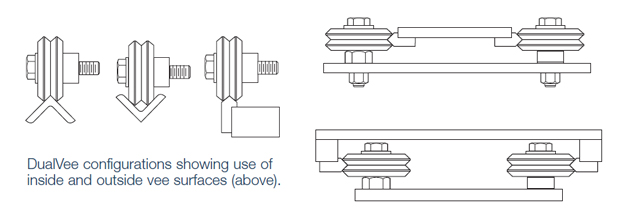
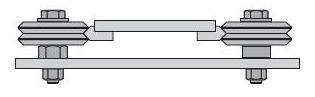
INBOARD mounting is when the guide wheels are placed on the outer edges of a track plate with the vee-edge tracks fitted into the vee-groove. For example:


OUTBOARD mounting also fits the vee-track into the guide wheel groove but instead of the wheels being on the outer edge of the track plate, the vee-tracks fit the outer edge of the wheels. This setup puts the wheels inside the aligned vee tracks. Like so:


EXTERIOR mounting involves an entirely different track. These tracks have a groove of their own so the outer edge of the DualVee fits in the track valley, creating a diamond-shaped space between track and wheel. Here's what it looks like:


All of these mountings are created using bushings (standard or low profile) and journals available in both concentric and eccentric versions. This allows for the best possible adjustment for each application. Our application engineers recommend that wheel plate assemblies be constructed with concentric bushings on one side of the plate and eccentric bushings on the opposing side.

But that's just the basics of guide wheel mounting. At Bishop-Wisecarver, we're always looking for out-of-the-box applications. Our imaginations get hungry for something different!

One of our customers doesn't use a track plate at all, Leslie said, instead they use DualVee wheels as guides for wire feeds. Another customer mounted size-0 DualVee guide wheels onto a circular tensioner to wrap paper around transformers. His creative application won one of our video contests — check out the video from last year.

DualVee has also been used for applying a moving load in a press application (pictured below) — no guide tracks needed! Instead, the wheels are being used to apply pressure against a matching 90 degree edge. Now that's different!


Those are just a few examples, but we know more are out there! Our application engineers talk to you every day, and it's always fascinating to us to hear about these unique designs.

Tell us how you reinvented the wheel, so to speak ... or at least reinvented how the wheel is being used. Comment here or email us and we'll feature your feedback on our blog! We will talk to BWC's Project Engineer Brian Burke this week about your feedback and will feature the story in another edition of "Coffee Chat."


*Click on the photo to enlarge* Leslie sketched out for us the various ways a DualVee linear guide wheel can be mounted. You can see in his drawing the different mounting types: "Integral, Swaged and Journal Assemblies," "Integral Bushing” and "Standard” for concentric only, eccentric only and both.