Showing posts with label linear motion. Show all posts

Monday, August 3, 2015

Fueling STE(a)M Education with Art and Creativity

Source: Southern Illinois University
Ruth Catchen has gone from opera singer, to music educator to advocate for the arts in technical education. The Colorado-based consultant has gained national attention for her unique approach to Science, Technology, Engineering and Math—or STEM, as it's commonly called. 

Add a dash of creativity to the equation: STEAM + Art = STEAM.

STEAM, she says, is the most logical way to learn.

"It is a way of learning that maximizes the concept of divergent thinking," she explains on education blog MiddleWeb. "We need the arts and our ability to communicate to do anything. As well, we must view things from the eye of a critical thinker, which is one who constantly wants to solve problems or make things work more efficiently."

That makes sense to us. Creativity matched with technical skill, of course, yields innovative results.

A 2014 study by the American Society for Engineering Education noted that STEM education is so successful because the teaching methods are inquiry-based and centered around students. It engages students in solving real-world challenges. It encourages teamwork. It shows how to use mathematics in a meaningful way that students will actually use later in life. 

STEM is a specific guideline for integrating and applying math and science to create solutions for real problems. It requires a high level of focus. 

In a way, the process already involves art, by requiring students to design products or communicate by writing or speaking about a solution. 

Through her pilot STEAM program, Catchen is showing how art can inform her pupils' design, presentation and creative planning.

That doesn't mean her students show how molecules move through interpretive dance, Catchen jokes. 

"Instead, it allows different neural pathways (we might call them head and heart) to work in harmony," she wrote. "Although humans cannot use both neural pathways at once, they can process and use critical thinking skills to combine the experiences from both, creating a better outcome."

STEAM lends balance to a rigorous technical curriculum. It inspires the kind of out-of-the-box thinking that takes engineering to the next level.

In a column on the need for more "STEAM power" in American education, Bishop-Wisecarver President Pamela Kan said it's all about balance. 

"Innovation requires a creative mind," she wrote, "and what better training ground than the arts to open up the realms of creativity?"

In a conversation with NOVA Education, public school art teacher and Rhode Island School of Design alumna Meghan Reilly Michaud spoke about how the art-science connection has the potential to transform the 21st century economy by inspiring a generation of creative makers. We've posted the clip below.


Monday, May 4, 2015

Rewarding the Ethic and Ingenuity of Local Eagle Scouts

Image by Rennett Stowe, via Wikimedia Commons

In 1912, a 17-year-old Long Island native became the Boy Scout of America's first Eagle Scout. Arthur Rose Eldred went on to study agriculture at Cornell University, enlist in the U.S. Navy during WWI and lead a distinguished career as an executive in the railroad industry.

More than 2 million young men have since achieved the Boy Scouts' highest rank. Time and again, research has demonstrated that boys who obtain the vaunted award go on to create a positive impact on society. According to researchers at Baylor University, Eagle Scouts are more goal-oriented and well-networked. They tend to have closer relationships with friends and family, donate to charity and improve their neighborhoods. They tend to assume leadership roles at work or in the community. 

Notable Eagle Scouts include astronauts Neil Armstrong and James Lovell, pro baseball player Hank Aaron, adventurer Steve Fossett, movie producer Steven Spielberg and Microsoft founder Bill Gates. Bud Wisecarver, the inventor who founded Bishop-Wisecarver Corporation, was among their ranks. As was his brother, the late Bob Cooke Wisecarver, a naturalist in the Bay Area. 


Bud Wisecarver.
That's why, in honor of the Wisecarver brothers, we're proud to provide two $1,000 scholarships for Eagle Scouts from the Mt. Diablo Silverado Council. The scholarships will be awarded at an annual Eagle Scout, Quartermaster, Silver Award Recognition Banquet this week in Danville, Calif. 

"We are honored to provide these scholarships and help Eagle Scouts who have already proven they are hard working and committed to serving others," says Pamela Kan, president of Bishop-Wisecarver and daughter of Bud Wisecarver. "Giving financial support as well as career insight and mentoring carries on a family tradition of Scout and community involvement, as my father and uncle were both Scouts and professionals who used their skills and passion to teach younger generations."


Pamela Kan.
The Wisecarvers were raised in the Bay Area, where they spent their manufacturing careers. Bud retired and focused his efforts on supporting vocational training at local schools and finding ways to connect the business and educational communities. 

A club of Eagle Scouts called Las Aguilas de Diablo will organize the May 7 dinner, which honors newly appointed Eagle Scouts and raises support for the council's endowment fund. The banquet gives Scouts a change to network with professional, civic and business leaders who match their career aspirations. Kan will be among them to talk about the opportunities and challenges of working in the manufacturing industry, an industry with incredible power to shape to build a better future. 

Every year, Las Aguilas de Diablo grants up to $7,000 in scholarships to college-bound Eagle Scouts. 

"When companies like Bishop-Wisecarver Group make an investment of time and money into our Scouts, it's a long-lasting benefit to the recipients, donor and community," says Bill Upson, vice president of Las Aguilas de Diablo. "These Eagle Scouts have already shown great determination and civic duty. These scholarships and networking opportunities provide the extra support that can help them realize their long term goals."

We couldn't agree more. 

Tuesday, March 17, 2015

Raising the Profile of Scientists and Engineers Through FIRST Robotics


"The average kid on the street can tell you the names of a dozen football players or basketball players or Hollywood stars. None of them can tell you the name of any famous living scientist or engineer."
—Dean Kamen, inventor, in an interview with CBS News

Right now, we're in the thick of competition season for FIRST Robotics. Some 400,000 kids in more than 80 countries are duking it out in a series of bouts with robots they designed and built themselves. It's all in good fun—intensely competitive and widely watched.
But the primary goal of the robotic sporting spectacle is about something more transformative than thrill of victory. Dean Kamen, the renowned inventor who established FIRST 25 years ago, says the long-running nonprofit promotes a cause near and dear to his heart. And the stakes are high.
"FIRST is all about changing our culture ... for the better," he told CMS Wire earlier this year. "More than 25 years ago, I saw a culture where celebrities and athletes were celebrated and revered, and scientists and engineers were not. I believed then and still believe not that our collective future depends on getting more kids from every background interested and turned onto science, technology, engineering and math (STEM), so that they might seek education and careers in these fields."
We couldn't agree more. 
It's about motivating students to understand, use and enjoy technology through project-based learning.
It's about propelling the next generation of scientists and engineers. 
It's about raising the profile of today's scientists and engineers. 
It's also about legacy, Kamen adds, a way of perpetuating his love of inventing to young people around the world. Kamen, an autodidact who holds more than 400 U.S. and foreign patents, is credited with saving thousands of lives with his healthcare inventions, among a myriad others.

FRC Team 4019 - Bridges Academy - Studio City, CA
Because to invent, ultimately, is to give—something he elaborates on in a TED talk you can watch here. 
It's a message that resonates strongly with us as a manufacturer of guided motion solutions. That's why we proudly support FIRST by donating large quantities of DualVee linear guide track for teams to use in building their robots. We also sponsor several local teams. This season, those teams are:
  • FRC Team 1458—Red Tie Robotics, Monte Vista High School in Danville, CA
  • FRC Team 3470—The Patriots, Heritage High School in Brentwood, CA
  • FRC Team 4019—Bridges Academy, Studio City, CA
  • FRC Team 692—The Fembots, St. Francis High School, Sacramento, CA

To learn more about our FIRST sponsorships, including how your team can become a sponsee, click here. 

Monday, January 26, 2015

DualVee Vacuum Wheels Nominated for Golden Mousetrap Award

The Golden Mousetrap Awards recognizes technologies driving progress in the design and manufacturing field. The program, hosted by UBM Canon, awards companies contributing to the renaissance of American manufacturing and promotes engineering and manufacturing as viable career paths for the next generation.

That's why we're proud to announce that Bishop-Wisecarver was named a finalist in the annual Golden Moustrap Awards, for our DualVee Vacuum Wheels.

These vee wheels were designed specifically for vacuum environments and processing equipment where it's tough to use other guided motion products.

DualVee Vacuum Wheels are linear guide bearings with precision-ground 90-degree surfaces for applications in testing chambers and ultra-high vacuum environments.

It's a product suited for applications in research and development, package sealing, materials science, space testing and simulation and many other fields.

We put together a handy FAQ page about these new bearings here.

Here's a link to the Design News feature about the nomination.Winners of the Golden Mousetrap Awards will be announced Feb. 10 at the Anaheim Convention Center as part of ATX West. We look forward to being part of the action!

Friday, September 12, 2014

Bishop-Wisecarver Builds an Automated Ice Bucket Machine to Support ALS

The engineers at Bishop-Wisecarver built an automated ice bucket machine for the ALS Ice Bucket Challenge. Not only did we participate, but we donated money and matched our employee's contribution!

Bishop-Wisecarver President, Pamela Kan, describes her experience:

"A good friend of mine and one of our distributors challenged Bishop-Wisecarver Group to participate in the ALS Ice Bucket Challenge to support the fight against this disease. I accepted the challenge and tasked our engineers to build an automated ice bucket machine using our components because after all we eat, breathe and live MOTION!

I stood nervously under this big bucket filled with ice cold water, regretting that my engineers built a slow pour functionality. You haven't lived until you feel a steady pour of ice cold water rolling down your back while your entire company burst into fits of laughter. After all was said and done, I'm extremely proud of the work everyone did to build this machine and that we supported an amazing cause.

We would like to challenge our customers, suppliers and distribution partners to the ALS Ice Bucket Challenge."

Watch and Share this video on YouTube!

https://www.youtube.com/watch?v=tlVgyjGVeH8


Want to share your ALS Ice Bucket Challenge Video? Post the link of your video on the comments below!

Friday, August 9, 2013

What's the Difference Between Lean Manufacturing and Green Manufacturing?

When Michigan-based seals and gasket maker FNGP enacted a lean manufacturing initiative in 1992, it slashed staff in one particular department from 21 to three, its square footage from 2,300 to 1,200, and upped production from 1,155 to 1,800 units a month. Productivity rose from 55 monthly units per employee to 600 units.

As evidenced by the Midwest manufacturer, lean policies are good for business. But in improving efficiencies, the company also shrunk its carbon footprint, notes an article recently published on ThomasNet.com. The unintentional side-effect proves that the intersection of lean manufacturing and green initiatives are key to reducing waste.
Is Lean Manufacturing Green Manufacturing?
Is Lean Manufacturing
Green Manufacturing?

"The economic benefits are pretty obvious," Charles Cohon, a manufacturing executive, tells ThomasNet. "But if you look at the same numbers from the standpoint of what effect it would have on carbon footprint, you can see even greater benefits ... going from 2,300 square feet to 1,200 square feet, you've cut almost in half the amount of space you have to provide lights and heat to."

Bishop-Wisecarver Group is no stranger to the advantages of both lean and green. We're a certified Bay Area Green Business. In reaching for the distinction a few years ago, the company went through a process that included eliminating non-recyclable packaging and upgrading to Energy Star electronics, among other things. The certification had more than the effect of making the business of creating guided motion technology more sustainable, though: it was good for the bottom line.

"All the required changes were not just green but better for our business overall," Bishop-Wisecarver President Pamela Kan said back in 2010.

Our Vice President of Manufacturing, Aldo DeAmicis, reiterated Kan's point when he came aboard  in 2012. Lean manufacturing is about reducing and eliminating:

  • Overproduction
  • Defects
  • Unneeded movement
  • Unnecessary inventory
  • Wait times
  • Redundant processing and transportation
It's also, in a big way, about motivating workers to live up to their potential.

As ThomasNet points out, those priorities lend themselves well to improving sustainability by cutting greenhouse gas emissions, excessive water and power use and trash. It also keeps the people who work there safe and healthy.

We want to hear from you! Tell us in the comments about ways your company has implemented policies that qualify as both green and lean. [ CLICK HERE ] to check out the infographic we made about the symbiosis between lean and green manufacturing.

Tuesday, July 30, 2013

Manufacturing IS Technology


Gears, levers and other trappings of a steampunk contraption? Maybe you think of cartoon inventors like Maurice, Belle's father in Disney's Beauty and the Beast, with his coke-bottle goggles and bumbling attempts at various rudimentary forms of mechanical tinkering.
 
As manufacturers of linear slides and rotary guides, we know the importance of basic components, the bearings, gears and tracks that move things from one point to another. But these are only the building blocks for more advanced systems, which are poised to shape the future of the industry as well as the rest of the world.
3D printing technology is a manufacturing process
(photo credit: The Verge 2013)
 
It is likely that you have encountered or overheard some of the newer "buzzwords" that have been introduced to many laypersons, many of which were created in order to parboil complex cutting-edge innovations or indicate advancements beyond the cursory realm of simply "manufacturing". Today, you're more likely to hear words and phrases like "mechatronics", "advanced manufacturing", and "additive manufacturing", than simply, "manufacturing."


Maybe manufacturing has become a "dirty word," associated more with "dirty, dumb, boring [and] cheap" labor, as Bishop-Wisecarver Group CEO Pamela Kan poses in a post she wrote recently for GE's Ideas Laboratory. Perhaps the word "manufacturing" has become semantically outdated, which indeed justifies the industry's attempts to come up with contemporary lingo to more accurately describe the field in a way that makes sense.

When taken in accurate context, modern manufacturing is comprised of the latest and greatest innovations of our time. Surpassing the low-tech and common connotations of antiquity, modern manufacturing, both present and future, is high-tech: manufacturing is technology.

The Wall Street Journal published a piece last month that highlights this important definition. The article highlights the 11 areas of technology identified by the Advanced Manufacturing Partnership that will push manufacturing into the future. These emerging technological fields should be the focus of research and development in the U.S., the group says. So what are they?
  • Sensing, measurement, process control
    Manual processes: our past,
    but not our future?
  • Materials design, synthesis and processing
  • Digital manufacturing
  • Sustainable manufacturing
  • Nanomanufacturing
  • Flexible electronics manufacturing
  • Biomanufacturing
  • Additive manufacturing (better known as 3D printing)
  • Industrial robotics
  • Advanced forming and joining technologies
Kan mentioned before that it is a shame manufacturing has become a dirty word. However, with the exponential advancement of modern technologies (aka manufacturing), it's no problem to start making our language more specific to dispel whatever outdated notions the public still has about manufacturing being a thing of the early Industrial Revolution.

Changing the language can influence the national conversation in a way that encourages the next generation to choose careers in manufacturing and influences public policy to favor conditions that promote manufacturing innovation.


A number of emergent technologies
that apply to manufacturing


What do you think about the language we use to describe manufacturing? Tell us in the comments!

Friday, July 5, 2013

Tweets of the Week: From STEM to STEAM, Relying on Robots and Fun with Perpetual Motion

Happy Friday, everyone! We hope your Independence Day celebrations were full of fireworks, fun and family time (and and food ... lots of delicious food). We've been looking back at all the conversations we had on Twitter this week, ranging from white paper shares on linear slides and rotary guides to blogs about the changing perception of manufacturing and the need for more skilled labor in the workforce. Here are a few standout tweets, including links to the tweeps who originally shared them. Follow us for more at @BWCnews.

1. Why America Needs More STEAM Power via PamelaKan.Blogspot.com: Advanced manufacturing needs more than just a workforce educated in science, technology, engineering and mathematics. They need a working knowledge of the arts, too. Bishop-Wisecarver President Pamela Kan blogs about this changing shift in the way experts view education. Art, they say, develops out-of-the-box logic and the ability to think in multiple dimensions — exactly the kind of mindset that's increasingly needed in the field of additive manufacturing, right? (Follow Pamela at @peekan).

2. Our Youth, the Future Depends on Them via FIRST Robotics: Our friends at FIRST Robotics sent out a newsletter highlighting the various successes of teachers and students in their robotics education programs. Find more robotics-related tweets by following them on Twitter at @FIRSTweets.

3. Why We Will Rely on Robots via Product Design and Development: Sensationalists talk about how robots will replace humans in the workplace, putting skilled manufacturing workers out of a job. But really, robots are more on pace to become helpful collaborators, a tool to enhance output for people in manufacturing and engineering. Read how here. Also, follow PD&D at @PDandD.

4. UtiliTrak Linear Guides Run Parallel via BWG: Have an application that requires parallel linear guides? You might be interested in this application story about an inventor who used UtiliTrak to build a patient lift for ambulances. Follow Bishop-Wisecarver Group on Twitter at @BWG_Diversity.

5. 9 GIFs That Make Perpetual Motion Machines a Reality via Gizmodo: You know the overbalanced wheel and perpetual water wheel? These contraptions move on and on until ... well, friction has its way with motion and all comes to a stop. But at least online, through the magic of looped video we call GIFs, these perpetual motion inventions can move on and on and on in perpetuity. Enjoy! And for more interesting tidbits about technology and invention, follow Gizmodo at @Gizmodo.

Wednesday, June 26, 2013

Manufacturing Still Makes America Strong

Photo credit: NAM
In 1895, as Americans struggled to stay afloat in the thick of the nation's worst recession to date, a group of business leaders met in Cincinnati, Ohio, to form the National Association of Manufacturers (NAM). They met to decide a course of action, to take charge of troubling economic circumstances by lobbying the powers that be on behalf of the manufacturing industry, as NAM Chair Doug Oberhelman explains in this video summary of the association's mission and history.

"Working together, they knew they could make a difference and chart a course for the future of manufacturing in America," NAM's current President and CEO Jim Simmons reiterated in front of an audience in March. Reminding them that the trade association has stood by manufacturers during times both good and bad, he named some examples:
When the first Model Ts rolled off the assembly line,
... when our industry helped the United States win both world wars,
…when farmers left their fields to enter the factory gates,
…when newly built tract homes helped families live the American dream,
…when technology and robotics transformed our businesses,
…and when global competition challenged America’s manufacturing dominance…
...during all of this, NAM has been the voice for manufacturers.

Today, NAM claims 12,000 members who represent another 12 million makers in the U.S., Bishop-Wisecarver among them. Our CEO Pamela Kan serves on NAM's Board of Directors. The goal that drew those manufacturing leaders together 118 years ago remains upheld today, only more urgently as manufacturing becomes an increasingly instrumental driver of our economic engine.

NAM's aim now, in addition to rallying for public policies that support manufacturing, is to educate the public about its importance and ever-evolving role in today's society. Kan wrote a few months ago about a faulty perception of manufacturing as dirty, dumb, boring and cheap in a much talked-about article titled "When Did Manufacturing Become a Dirty Word?"

Modern manufacturing is technologically sophisticated and a key driver of global R&D innovation, Kan notes. Bishop-Wisecarver Group has grown with the times, from engineering linear bearings and other motion control technologies to venturing into the world of mechatronics.

Plus, for anyone debating what career to pursue, realize this: it pays very well (click here for a look at the median salary for a mechanical engineer, for example).

"If you go back a century, it's almost impossible to see how we got from there to here," Oberhelman remarks in the video. "Computers didn't exist, there was no air travel, and gas-powered automobiles were still on the drawing board. What a fascinating story and even more astounding is the role manufacturing and the National Association of Manufacturers have played in revolutionizing our country."

Watch the video here:


Thursday, May 23, 2013

Double Product Feature: Paper Towel Transfer Unit & Spool Handling Unit


DOUBLE FEATURE Too much of a good thing is a very good thing, and in today's application spotlight, we're featuring two HepcoMotion products back-to-back. Check out how two different products were used for motion without limits.

TRANSFER UNIT FOR PAPER ROLLS
Twin back-to-back oval tracks have carriages joined with support rollers, with connecting links for driving, that move paper towels from one place to another. This assembly combines the PRT2 (precision ring and track) and DTS (driven track system) product lines.

SPOOL HANDLING UNIT
The durability and strength of HDLS (heavy duty driven linear system) lies in its capabilities. The beauty of HDLS is that it utilizes heavy duty slides and actuates them by AT series belt. Both the narrow unit and the wide HDLS units feature left, right, and dual
output shafts, and gear boxes may be supplied directly coupled to units. Extended output shafts on gear boxes are also possible to drive two systems in parallel.

Optional shock absorbers and rubber buffers are available for HDLS systems. In this application example the gripper holds a spool of kevlar fiber tape during the production of high performance composite storage tanks. The spool gripper rotates on a ring and moves on the HDLS unit.

To learn more about these application stories and
others, visit us online: bwc.com/app_stories.php

Tuesday, May 7, 2013

Watch, Read, Listen, Do: Motion Control for Halloween Props and the Greatest Show (and Tell) on Earth


Albert Einstein said, "Imagination is more important than knowledge."
Just as it's critical to keep your education up to date, it's even more crucial that your imagination be fed daily doses of inspiration. Part of what lights up our creativity here at the Bishop-Wisecarver Group is how well we keep current on the world around us. We're checking in on social media channels for the good and the great because we're more than just your linear guide specialist! We're also a specialty contract manufacturer and engineering service provider — a busy family of solutions looking for inspiration to spark new creative ideas every day. Here's a bit of what we found inspirational in the world of science, technology, engineering, art, and manufacturing. Where do you dial in for the latest news?

[ Watch ] So Bad So Good writer Alex Wain asks, "Who needs an entire restaurant of expensive chefs, sommeliers, crisp cut waiters or a maître d’ when you have an army of 20 robots waiting for your command?" His article features a small restaurant located in Harbin, China that is attracting diners looking for something a little different. Now that's a lot of motion without limits! Check out the photos featured in this write-up.

Photo Credit: So Bad So Good
[ Read ] David Mantey, the Executive Editor at PD&D, recently wrote a cover story titled "Welcome to My Nightmare" that showcases how motion control and automation play a part in the making of Halloween props. The industry known for producing all things that go bump in the night is no stranger to the many imaginative uses of linear slides and rotary guides.

[ Listen ] President of Bishop-Wisecarver Group, Pamela Kan, was featured in the "7 Minutes With" audio series by Modern Distribution Management (MDM) on the impact of sequestration, the value of bringing manufacturing back to the U.S., why social media is part of the manufacturer's growth strategy, and more. Hear what she had to say!

Photo Credit: Bishop-Wisecarver
[ Do ] The Maker Faire is coming to the San Francisco Bay Area this month, so if you're in the area, don't miss out on this inspirational event! From life-size robotic giraffes to CNC routers that will make your woodworking dreams come true, it really is "the Greatest Show (and Tell) on Earth." Meet the makers and their creative designs in "a family-friendly festival of invention, creativity and resourcefulness." Tickets can be purchased online prior to the event.

Wednesday, May 1, 2013

Q&A for Naasik Akkas, Test and Automation Engineer


Naasik first started at Bishop-Wisecarver
as an intern last year.
Naasik Akkas joined the Bishop-Wisecarver team late last year, bringing with him a mechanical engineering degree from UC Berkeley and with an internship at Bishop-Wisecarver already under his belt. Invigorated by the knowledge and experience that he was able to gain here during the summer of 2012, Naasik focuses his work on mechatronics as a Test and Automation Engineer. Not only was the team excited to have him the first time, but even more enthused that he came aboard after completing his education. Have a question for Naasik? Leave a comment in the comments section below!

Question: Why did you want to be an engineer, and did you always know that this was something that you wanted to do, or was it a decision that emerged later?

NA: My dad is a mechanical engineer and I saw what he got to do, so since I was very young I always thought I wanted to be a mechanical engineer. Once I was in high school I got really interested in physics and learned more about mechanical engineering, and that helped me decide that it was something I really wanted to do.

Question: Where did you receive your education in engineering and in what area did you specialize?

NA: I received a B.S. in mechanical engineering from UC Berkeley with an emphasis in controls and robotics. I ended up working on two sizeable projects: the first project was a robot that used computer vision to detect people and follow them around, and the second project was an amphibious vehicle that is able to travel on both land and water.

Question: What kind of job experience did you have before joining the Bishop-Wisecarver team?

Answer: I interned at Bishop-Wisecarver during the summer of 2012 doing job functions very similar to those that I am performing now. Before that, I had an internship in Bangladesh doing work with industrial automation.

Question: What advice would you give to a young person who is interested in a career in engineering? Let’s say a middle school student or a high school student.

Answer: Always try to improve your math and physics knowledge. Those are incredibly important subjects for a mechanical engineer to master. Also, for high school students I would say definitely go above and beyond the normal coursework. Most importantly, try to make real world connections with everything you learn.

Question: What's the most rewarding aspect of being an engineer?

NA: When something you build actually works.

Question: Technology plays a big role in the type of engineering that you do. Is it a lot of effort to stay abreast of recent technologies used in your area of expertise?

NA: It can be, but if you are always interested in the subject then it's easy to stay on top of it. I learn a lot from Ali Jabbari (Vice President of Engineering) and George Anwar (Consultant). So talking to the right people and being around the right people in the field helps. Also, articles on the internet and blogs that discuss technology are very useful.

Question: Which aspects of your role at Bishop-Wisecarver do you appreciate the most? In what areas do you find yourself working the hardest?

Answer: I appreciate the amount of creativity we are able to exercise with selecting components and also in other aspects of decision-making. I appreciate the ability to be able to make these types of decisions, and the level of responsibility that we are given is great because I get to learn more by being tasked with solving these problems.

Question: What’s your favorite quote, or personal motto?

Answer: “Victory is won not in miles but in inches. Win a little now, hold your ground, and later, win a little more.” — Louis L'Amour

Question: Do any of your hobbies outside of work relate to your job, any technical trades, or anything having to do with engineering?

Answer: I play with microcontrollers like the Arduino and the Lego NXT Robotics platform to build small devices and work on personal projects for fun. I like making home automation machines.

Question: Where do you see yourself in five years?

Answer: I want to see myself running my own industrial automation and robotics company.

Friday, April 26, 2013

Q&A With Mechatronics Engineer Garrett Diulio

Garrett Diulio working on a large
custom actuated linear guide (belt driven).
Garrett Diulio joined the Bishop-Wisecarver Group earlier this year, and with him comes great enthusiasm for all things mechatronic related. As our Mechatronics Engineer, Garrett is focused on projects that require both mechanical and electronic expertise. Have a question for Garret? Leave a comment in the section below!

Question: Why did you want to be an engineer, and did you always know that this was something that you wanted to do, or was it a decision that emerged later?

GD: For me, it was a decision that came later in life, during my first semester of community college. I liked math and science, and fixing things. I’ve always had fun building things and taking things apart and putting them back together.

I started out as an electrical engineer, and I realized shortly thereafter that my true passion was in mechanical engineering. It is so broad, probably the broadest field of engineering. You are exposed to everything. There is no job a mechanical engineer couldn’t do.

Question: What are your earliest memories of putting things together?

GD: I remember trying to take apart a cell phone as a little kid.

Question: Where did you receive your education in engineering, and in what area did you specialize?

GD: I received a degree from UC Berkeley and my major was mechanical engineering. I had to do a senior project that was very similar to what I’m doing here at BWG; my senior project was on mechatronics. Mechatronics is just a fancy word for a combination of electrical, software, mechanical, and controls engineering.

Question: What kind of job experience did you have before joining the Bishop-Wisecarver team?

GD: I had a few internships. I had one internship where I did a lot of mechanical design, which I do a lot of here as well, although the industry was different (the medical field). It was a company that made heart pumps and I had to design the connectors in CAD.

I had another internship as an analyst reviewing bone strength data, and I would use finite element analysis in order to find the varied strengths from patients; usually older patients. The software was used to predict when patients could potentially fracture their hip or pelvis… they recently got FDA-approved.

I did have a third internship that are similar to my duties at Bishop-Wisecarver. My responsibility for that job was to figure out how to make the robot navigate autonomously through a maze. I focused on software and the electrical portions of the project. This was preliminary research for a firefighting robot.

Question: What advice would you give to a young person who is interested in an engineering focused career? Let’s say a middle school student or a high school student.

GD: Make sure you are very passionate about the aspect of engineering you select — it really makes a difference in engineering. You can really tell a difference between people who come to work just to earn a paycheck and those who truly love what they do at the office. In engineering, it’s the little details that matter the most.

Question: What's the most rewarding aspect of being an engineer?

GD: Finishing a project — the point at which all elements are functional and operating the way they’re supposed to... that's a really satisfying feeling.

Question: Technology plays a big role in the type of engineering that you do. Does it require much effort to stay abreast of recent technologies used in your area of expertise?

GD: Going back to how passionate you are — if it’s what you love, it’s pretty easy to stay on top of it all. You’ll be willing and have the desire to keep learning, and it will come naturally to you; second nature almost. I think the key is always trying new things.

Question: Which aspects of your role at Bishop-Wisecarver do you appreciate the most?

GD: The thing that I must focus on the most is planning and scheduling; ordering due dates and logistics. It is always critical to make sure that everything comes together in the allotted time frame. Without planning and preparation, you are doomed.

Question: What’s your favorite quote, or personal motto?

GD: “The only way to do great work is to love what you do. If you haven’t found it yet, keep looking. Don’t settle.” – Steve Jobs

Question: Do any of your hobbies outside of work relate to your job — any technical trades or anything having to do with engineering?

GD: I still work on my senior project sometimes. It’s kind of a hobby. I still work on it because I want to showcase it someday. You think you’re close to perfection, but really, there’s always more to refine.

Question: Where do you see yourself in five years?

GD: Within five years, I hope to have created and launched my own product line based on the concept of autonomous machinery.

Thursday, January 17, 2013

#CoffeeChat: Stainless Steel Linear Slides with Brian Burke


SLIDING INTO PLACE The HepcoMotion® SL2 Stainless Steel Based Slide System is an adaptable addition to our range of linear rails, and offers the user with basic interchangeability with our line of GV3 linear guidance components such as stainless steel bearing assemblies, flat slides, spacer slides, etc. The SL2's complete corrosion resistance protects its linear motion bearings and ground stainless steel slides, which also comes with special surface treatment to beef up that corrosion resistance to meet U.S. Department of Agriculture standards for food processing applications.

We wanted to hear more about the SL2's capabilities, so we caught up with our [ Project Manager Brian Burke ] to pick his brain about this prominent part of our collection of guided motion technologies.

Q: How are SL2 rails similar or different from our GV3 product?
Brian Burke: The SL2 product line is a simplified subset offering of GV3 product made from stainless steel. The GV3 product line of linear guidance components is a diverse offering and includes a variety of linear guides with 70-degree vee edges, flat tracks, gear rack and pinions, carriage assemblies, guide wheels, cap wipers, accessories and components.

The GV3 linear guides are made of hardened 52100 carbon steel and are available in three grades of precision with bearings and track rollers also made from 52100 carbon steel. In the SL2 product line the most popular sizes and profiles from GV3 are available in 420C and 440C stainless steels and an additional offering is provided for assembled systems of carriage assemblies and tracks. At the core, SL2 is based upon flat tracks and double edge spacer slides made from 420C stainless steel with in the P1 precision grade with ground surfaces.

The SL2 product line does not include flat tracks or gear racks, but does offer carriage assemblies with stainless steel guide wheels and accessories such as aluminum flange clamps.

Question: How does the SL2 stand up in a wet, washdown environment? What about other types of harsh environments?
BB: SL2 can withstand moist environments much better than GV3 products because of the use of 420C and 440C stainless steel compared to the 52100 carbon steel. The 400 series of stainless steel is considered corrosion resistance steel, but can still oxidize and create rust. To improve corrosion resistance of 400 series steel, the spacer slides and flat tracks are fully ground to improve the surface finish. A ground surface has smaller bumps and cracks and much less surface area for the formation of oxidization. Therefore, the SL2 stainless steel tracks can withstand washdown environments better than GV3 products. Additionally, and screws, washers and fasteners are made from 300 series stainless steel.

Question: What materials are SL2 carriages comprised of? What's the benefit of each alloy?
BB: The carriage plates themselves are made from high strength aluminum and are surface treated for additional environmental compatibility. The guide wheels are made from 440C stainless steel with 300 series mounting studs and contain lithium based NLGI2 grease. These materials are more corrosion resistant that carbon steel alternatives found in GV3 products.

Question: Can SL2 rails be configured with any of our other product offerings? Which ones and in what scenario would you do that?
BB: SL2 is compatible with other GV3 products and can be combined or substituted if desired.  However, to maintain corrosion resistance of the entire assembly it would be best to stick to all SL2 products. Because the components are identical in form, and fit, alternates from GV3 can be utilized as is the case with cap wipers, track lubricators, and other accessories.


Question: What industries is the SL2 ideal for? What about food processing applications – what advantages does the rail bring to that industry specifically?
BB: SL2 can be utilized by any industry for applications where corrosion resistance is a concern. For the most part, SL2 is used in food production and packaging environments and clean room or low contamination environments. The corrosion resistance materials and surface preparations of SL2 make the product line well suited to applications in these industries.

Question: What's one of the most interesting SL2 application examples that comes to mind? Why did it work so well in that case?
BB: An interesting application for SL2 is pharmaceutical packaging operations where products are assembled into packaging and sealed for future use all inside a clean room environment.

[ To download a FREE catalog and CAD drawings, visit the SL2 product page ]

Friday, December 21, 2012

Top Five Twitter Posts: Force of Manufacturing, Solar Panel Stickers and an Engineering Hero


Smack-dab in the middle of the holidays and we're still busy as ever in cyberspace and on the manufacturing floor, making conversation online and guided motion solutions at our Bay Area headquarters. It's an exciting time of year. Let us fill you in on some of the chatter that defined our Twitter conversations this week, from the funny to the fascinating. Make sure to follow our future tweets at @BWCnews!

Credit: Motion System Design
1. The Force of U.S. Manufacturing in Motion System Design magazine: The glossy publication put together a nice piece on the "new normal" of global manufacturing and the role domestic industry plays in the field's worldwide growth. On the panel cited in this article is BWC's very own Pamela Kan, CEO member of various public advisory panels. In it, Kan talks about, among other things, the importance of manufacturing products in the U.S., the meaning of productivity and how we can improve domestic manufacturing.

2. Peel-and-Stick Solar Panels via Product Design & Development Magazine: For the first time, scientists have found a way to create flexible solar cells, bendable enough to fashion into peel-and-stick patches. The developing vastly widens the application of solar technology, the magazine says. We've achieve "the ideal: flexible, decal-like solar panels that can be peeled off like Band-Aids and stuck to virtually any surface, from papers to window panes."

3. Boeing, BMW Join Forces on Manufacturing Executive Blog: Recent advances of new composite materials, namely carbon fiber, to build super lightweight cars and aircraft has led BMW and airline giant Boeing. We look forward to seeing the innovation the partnership will breed!

Credit: Big Beacon
4. The Jackhammer Elegies: A Novel with an Engineering Hero via Big Beacon: A few blogs posts ago, we suggested some pretty cool gift ideas for engineers. But here's another we'd like to retroactively add to the list. It's a book whose protagonist, Scott Carter, is a civil/structural engineer. Click through to read more about the novel in an interview with its author, Stefan Jaeger.

5. Skills Gap to Drive Manufacturing Power Shift via Manufacturing Engineering Media: While we talk about reshoring manufacturing and repatriating domestic profits, here's a piece that reminds us how a shortage of skilled laborers will keep pushing manufacturing overseas unless the U.S. comes up with a policy to counteract that. Do you think we'll see a formal U.S. manufacturing policy in 2013?

Friday, December 14, 2012

Top Five Twitter Posts: Made in America, Manufacturing Semantics and Facebook's BWC Year-in-Review


Just a few weeks left of 2012 — enjoy the last few days of the year! We've had quite the week on Twitter, sharing an article published by our company president, some manufacturing news, wishing students luck on their engineering finals and lots of other happenings. We'll spotlight a few of our favorite moments right here. Become part of the action by following this linear guide manufacturer on Twitter at @BWCnews!

Credit: Photo Cards Direct
1. December is 'Made in America' Month via Industry Week: Though we recognize the importance of the global economy and our increasing interconnectedness to industry in other countries, we also take pride in our heritage as an American manufacturer. According to Industry Week,  "A recent study by the National Retail Federation revealed that the average American will spend $700 in holiday purchases this year for a total of $465 billion. If that money was spent entirely on U.S. made products it would create 4.6 million jobs."

2. Is Manufacturing Still a Dirty Word? via Ideas Lab by GE: BWC President Pamela Kan shared her thoughts on the negative connotations surrounding the word — and the industry of — manufacturing. Does the younger generation perceive it as dirty, cheap and blue collar? How can we change that view to make them realize it's increasingly advancing, it's high-paying, it's a job to vie for and it's the backbone of our economy? A big thank you to the folks at General Electric for sharing Pamela's blog post this week!

3. Gift Ideas for Engineers via BWCnews.blogspot.com: Maybe you've already completed your holiday shopping, but in case you haven't, we've compiled a list of some gifts an engineer might enjoy. From visible-gear clocks to a piston coffee mug, these selections are sure to amuse the receiver ...and may be the talk of the office.

Credit: BWC
4. Bishop-Wisecarver Corporation Fan Page via Facebook.com: We celebrated a mini milestone later this week when we finally reached more than 400 fans on our Facebook page. Nice way to wrap up this mid-December week! Join us on there for updates, photo posts, polls and a running log of what we're up to throughout the week. Oh, and an added end-of-the-year bonus: Facebook compiled a Timeline of 2012 highlights for us. Reminisce with us here!

5. Six Things to Know About the Future of Manufacturing via The North Jefferson News: Understanding the evolution of manufacturing in the U.S. and abroad is key to understanding the trajectory of its future. That's why it's important to note that manufacturing is dynamic, it's diverse, that its future consumers live in the developing world as well as other insights shared in this article. Great read!

Friday, December 7, 2012

Top Five Twitter Posts: Linear Guides, Infographics for Engineers and Immortal Jellyfish


A product launch, a manufacturing renaissance, new breakthroughs in science and innovative perspectives on the state of our economy — those and other topics blipped across our radar this week. Just to capture some of that conversation, we've summed some of the most notable tweets here. Become part of the conversation, or suggest nominations for our next Twitter Friday installment, by tweeting us at @BWCnews. Happy holidays!

1. Download a Free QuickTrak® Linear Guide Catalog on BWC.com: We recently announced the launch of our latest product, a linear guide called QuickTrak. It's a line of modular cut-to-length and simple-to-build parts. And now, you can download the product catalog from our website!

www.bwc.com 
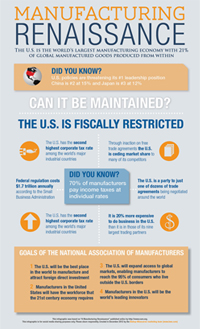
2. Infographics for Engineers on BWC.com: Throughout the year, we've steadily built up our collection of infographics geared for the engineering crowd. These are useful visuals that lay out information in an easy-to-digest printable poster formats. Our latest one explores the much-talked-about manufacturing renaissance. Click through to download, print and hang a copy at your workspace!

3. Jellyfish Might Prove Immortality a Possibility via Discover News: If you picked up a copy of the Sunday New York Times this week, you may have read the feature on how a scientist in Japan is exploring a specific type of reverse-jellyfish that may hold the secret of everlasting life. How much of the story's optimism toward the study is merited? Here's a science writer's interesting take on the phenomenon.

4. The Insourcing Boom in The Atlantic: Here's another story that got our Twitter friends yapping — one about the ever-growing trend of bringing manufacturing back to the U.S. from China. Is outsourcing an outdated business model? You tell us.

5. Is a Manufacturing Revival a National Security Necessity? on Manufacturing Executive Blog: People talk about having to build up a national manufacturing policy because the industry is so vital to the health of the economy as it generates jobs and acts even as a bellwether to the broader health of the nation. A report issued recently further underscores the importance of manufacturing by arguing that it's vital to national security and helps minimize damage in event of natural disaster — or at the very least speeds up recovery. Click through to read the blog and download the report.

Friday, November 30, 2012

Top Five Twitter Posts: Linear Guides, Manufacturing Jobs and Mass-Produced Carbon Fiber


We're on the last leg of the second-to-last month of 2012. Can you feel the time slipping past us? This has always been a busy time of year for us, planning the next year's trade shows, gearing up for a new calendar and wrapping up loose ends before the holidays. But that doesn't mean we don't have time to scope the Twitterscape for some interesting industry news for you to peruse. Here's our latest collection of Twitter gems. Stay posted on what we're up to in the future by following us at @BWCnews!

1. Bishop-Wisecarver Introduces QuickTrak Linear Guides on bwc.com: We announced this week that we now offer a line of modular linear guide components and sub-assemblies we call QuickTrak® Linear Guides. These guides help manufacturers and automation solution providers put together machines with guided motion systems quicker and easier. To cite our Vice President of Engineering Ali Jabarri, it's basically an industrial-grade erector set! So many possibilities!

2. BWC is Hiring via bwc.com: Our company is growing. Part of that growth means we need more people on board to help roll us into the future. We're hiring a sales manager, a marketing analyst, a materials planner and an applications engineer. To read descriptions of each job, click through the link. We look forward to receiving your applications!

3. Makers Row — a Database of Manufacturers on Fast Company: Imagine you have an inventive idea and need a specific component to make it a reality. Say it's a belt or a guided motion system. But how do you find the people who make it? That's where Makers Row comes in. It's an online database of American manufacturers. It's like a one-stop shop for U.S. makers. Definitely take a minute to see what we're talking about — a great resource, and it's free!

4. Manufacturing Advances Bring Carbon Fiber Closer to Mass Production on Auto Blog: There wasn't a single breakthrough but a combination of advances that could make man an automaker's dream of mass producing carbon fiber come true. The raw material costs and slow manufacturing cycle has historically kept the product on the pricey side... until now! Click through to find out just why the cost of it's on the decline.

5. Staples Launches "Easy 3D" Printing Service via Fast Company: And it's just in time for some awesome holiday parties, the article notes. Additive manufacturing is about to debut at select Staples now that the company's partner Mcor announced the launch of Staples Easy 3D. If you're in Belgium or Holland, you can expect to see the service by early next year!

Friday, November 23, 2012

Top Five Twitter Posts: Being Thrifty, the 'Barbie Box' and a Manufacturing Renaissance


Turkey Day has come and gone, and we hope you had a filling feast with your friends and loved ones. Despite this being a holiday week, so many interesting conversations held our attention on Twitter. Though we specialize in manufacturing guided motion technologies like linear slides and rotary guides, so many advancements in science and industry capture our attention. Here's a sample of what made us pause and think on Twitter this week. Keep up with the action in real time by following us at @BWCnews! Enjoy your leftovers!

1. A New Era of Thrift on Manufacturing Executive blog: Could the recent recession and a continued weak economy have created a new era of penny pinchers? If so, what implication could that have on the manufacturing sector? Columnist Chris Chiampinelli asks that question in a blog post he published this week. He says, "I think it will. And the consequence will be a new era of thrift. We’ve seen it even in the quarterly numbers of the software providers we cover. Businesses are looking to patch what they have instead of buying up to the latest release. Consumers, too" What do you think? Do you believe that consumers are less likely to spend, even with an uptick in economic vitality?

2. Stanford Engineer Gets Girls Thinking Outside the 'Barbie Box' on Deseret News: A lot of ink, digital and actual, has been spilled over the question of how to attract more children to the wonder of engineering and manufacturing. But what about girls, specifically? What toys, media and marketing has been directed toward the young female demographic to ignite their interest in "making things?" One Stanford grad developed a tactile answer to that in the form of a new kind of toy, one that's appealing to girls without degrading them to purely pop culture and fashionista-flavored interests.

3. A Manufacturing Renaissance on National Association of Manufacturers: As the manufacturing industry debates over how to revive domestic manufacturing, no matter how interconnected the industry is to the larger global economy, NAM has published a report that crystalizes some ideas into four simple points about how to ressurect U.S. industry. We tweeted a link to the report and even blogged about the topic earlier this week. We'd love to hear your thoughts about it!

4. A Journalist Tries to Debunk the Manufacturing Workforce Shortage on Manufacturing Executive blog: So many stories pop up about the shortage of skilled workers compared to the need for them in the manufacturing sector. But is the discrepancy as severe as it's been reported? Some journalists beg to differ. Then again, there's always a rebuttal. Here's a good distillation of the discussion right here. Does the reported shortage affect your business? How severe is the shortage to your company? Myth or fact?

5. The Potential of Data and Human Capital to Change the World on Fast Company: For the first time in history, we have massive amounts of data at our fingertips. We can connect millions of peopel through the internet. We can exchange ideas in a way we've never been able to interact before. It's a crazy advanced time to innovate, to brainstorm. Fast Company this week published a blog post on exactly how valuable a resource we have in that interconnectivity. What about you — has that availability of human resource, of data, helped advance your own research? What does that mean for manufacturing?