Tuesday, February 12, 2013

Women Moving Manufacturing Forward: STEP Ahead 2013 Awards


Pamela Kan, President of Bishop-Wisecarver Group, was honored this month at the annual event with 121 other women for their important roles in manufacturing. STEP Awards was established in order to honor numerous female leaders in the manufacturing industry.

“These 122 women are the faces of exciting careers in manufacturing,” stated Jennifer McNelly in a recently released press announcement, President of The Manufacturing Institute (MI).  “We chose to honor these women because they each made significant achievements in manufacturing through positive impact on their company and the industry as a whole.”

The STEP Awards are part of the larger STEP Ahead initiative launched by MI, Deloitte, University of Phoenix, and the Society of Manufacturing Engineers, to examine and promote the role of women in the manufacturing industry through recognition, research, and best practices for attracting, advancing, and retaining strong female talent.

According to this study, 51.3% of survey respondents believe that women’s under-representation in manufacturing is driven by the perception that the industry culture is biased towards men. Research through this study also showed that the concern about the stability of U.S. manufacturing is tremendous. Survey respondents ranked manufacturing #1 as a staple of the U.S. economy. However, when asked about their tendencies toward the field of manufacturing as a prospective career, many proclaimed that it is a field "...for someone else.”

Fortunately, through the advancement and promotion of Science, Technology, Engineering, and Mathematics (STEM) education, there is increased hope that women will have easier access to the manufacturing industry through both technical preparation, as well as through expanded awareness of the career options available within the industry.

Superseding the idea that manufacturing is a withering field will be tantamount, the Deloitte and MI study found on behalf of respondents. Recommendations for the coming years including building strong employer brands and improving the external image of the industry so that manufacturing job satisfaction for women--which generally trends high--is reflected outwardly in public reflections of the field are noted in the study.

What do you think? Weigh in on this hot manufacturing topic. Get active on Twitter using the hashtag #mfgwomen

Tuesday, February 5, 2013

#CoffeeChat: QuickTrak, Fast Track Intro to Modular Linear Guides


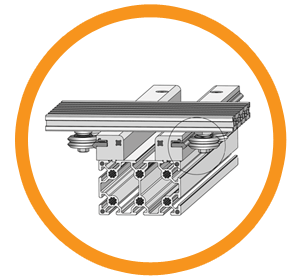
BACK ON TRACK The QuickTrak® modular based platform of linear guides and sub-assemblies was created to meet the needs of customers who required modification of existing machines — a quick, simple way to mount guidance systems. Think of it like an erector set for manufacturers, engineers and automation solution providers. These guides mount easily onto any beams with T-nut and T-slot-based kit of parts.

We sat down with one of our engineers, Leslie Lui, over coffee to discuss the possibilities of this particular type of motion solution. Here's what he had to say:

Why did we create this product? 
LL: QuickTrak was developed to aid machine builders seeking linear guidance solutions that offer flexible design and easy-to-assemble characteristics.

Most linear guide products require highly customized precision-machined components and mounting features in order to be integrated into an application. We made QuickTrak to cut the amount of time and work required for machine builders to design and build linear guide systems into their applications.

The QuickTrak product philosophy is about building linear guide systems from modular, cut-to-length and easy-to-piece-together parts instead of custom-designing the system and components from scratch.

Who benefits from using QuickTrak?
LL: QuickTrak benefits any machine builder who wants to quickly add a customized linear guidance system into their application with as little assembly and machining effort as possible.

How does QuickTrak help machine builders?
LL: QuickTrak support assemblies permit DualVee® track to be easily mounted to applications without the need for careful machining and preparation of any mounting substrates. QuickTrak single-edge and double-edge track supports can be mounted onto standard T-slot extrusions with readily available fasteners and do not require any mounting substrate machining. QuickTrak double-edge track supports can also be mounted to most flat surfaces, requiring only the machining of suitable mounting holes.

QuickTrak wheel plate assemblies are composed of specialized sets of wheel and brake components fastened onto custom profile T-slot extrusion wheel plates. QuickTrak wheel plate assemblies are designed to be put together with simple hand tools.

The T-slots serve as mounting features for both the customer payload and wheel plate assembly components. The T-slots span the entire width of the wheel plate, providing far more mounting possibilities for customers than individual mounting holes. The width of the wheel plate can be quickly and easily sized to match customer-determined track support spans and accommodate specific extruded stock. Optional brake sub-assemblies permit wheel plate assemblies to be quickly locked in any desired position on their track support assemblies.

[ Click here ] to download free CAD drawings, catalogs, and data sheets about QuickTrak

Monday, February 4, 2013

Think Like An Engineer: Linear Guide Technologies


Is your brain in motion? Today is the first Monday of February, so l
et us help jump start your brain and get those wheels turning with one of our "Think Like an Engineer" game posts.

In this week's edition, we're featuring a linear guide technology matching game — great for educators to share in the classroom,
FIRST robotics students, and anyone else looking to brush up on all things related to linear motion.

In today's game, we're asking you to match up the following terms with the appropriate images: cam follower, plain bearing, profile rail, and profile guide wheel.

[ DOWNLOAD ] the game and get started — good luck! You can check out other fun games like word search and crosswords for engineers on our website.

Friday, February 1, 2013

Top Five Tweets of the Week: STEM to STEAM, Bearings for Figure Skating, and California Job Losses


Rolling into 2013 with lots of exciting announcements about new engineering services and contract manufacturing offerings, we still have a keen eye on all things motion-related and that which inspires us through STEM initiatives (science, technology, engineering, and mathematics). But wait — have you heard the latest buzzword around STEM? What really caught our attention was topics related to "STEAM", which incorporates "art" into the acronym, is a movement championed by the Rhode Island School of Design (RISD) and adopted widely by institutions, corporations, and individuals.

www.bwc.com
1. STEM-to-STEAM: An Initiative That Brings Alludes that Technology Requires Creativity via www.stemtosteam.org: We're really excited about the objectives of this movement; Transform research policy to place Art + Design at the center of STEM, encourage integration of Art + Design in K-20 education, and influence employers to hire artists and designers to drive innovation. The website also says that STEAM was developed with the notion that technical know-how alone may not be enough to drive innovation, so as the United States marches further into the 21st century, institutions, companies, and other organizations alike are becoming, shall we say, more creative. In order to solve our nation’s current problems, an interdisciplinary, well-rounded approach that blends vital fields may be key.

2. California Loses 2,600 Manufacturing Jobs in December 2012 via www.cmta.org: In terms of manufacturing job growth, California did not finish the year out strong and did indeed continue to shed manufacturing jobs. In fact, according to 2001-2012 data, California manufacturing is declining 13% more than the U.S. In addition to that, California’s manufacturing base has eroded 32% since 2001 – a loss of over 600,000 manufacturing jobs that paid, on average, $20,000 a year more than service jobs.

3. Do Engineers Use Social Media? via www.element14.org: Yes, according to Calgavin, who reports that a whopping 61%, or over half of all engineers, use social media for work-related activities. According to their study, engineers use the following social media channels accordingly:
  • Google+: 33% 
  • LinkedIn: 43% 
  • Twitter: 22% 
  • Facebook: 67% 

And, their favorite types of content? Videos, articles, white papers, images, webinars, interviews, and forums!

4. Smart Manufacturing Will Rise to Global Challenges via www.controlglobal.com: Rockwell Automation’s CEO Keith Nosbusch has an interesting take on the future of manufacturing: "The coming decade will be the first in 200 years when emerging-market countries contribute more growth than the developed ones," says Nosbusch. He attributes this theory primarily to the high economic uncertainty within the United States, that is putting the brakes on current and future growth possibilities. Emerging markets, on the other hand, are developing to the point where increased manufacturing is needed, and may be able to occur in a much more cost-efficient, economically sound climate. Nosbusch attributed smart technology to 3 key drivers: technology, talent, and infrastructure.

www.about.com
5. Did you Know That Figure Skating Harnesses Use Ball Bearings? via www.about.com: Pulley systems, with harnesses, are used in figure skating to help ice skaters master jumps. These pulley systems utilize ball bearings and are of substantial strength in order to bear the weight of figure skaters of a variety of ages and sizes. The pulley system is operated by the coach or trainer, who helps hoist the skater into the area, and/or stabilizes their “in air” position to prolong a jump.

With that said, falling on hard surfaces can still make a skater prone to injury, so the more help a skater can get during his or her training, even in the form of jumping assistance, the better! Such equipment can be extremely useful to the skater who is trying to master his or her moves, reducing chances of hard falls.

THANKS — We hope you enjoyed this week's wrap up! Join us at @BWCnews for daily updates!

Thursday, January 17, 2013

#CoffeeChat: Stainless Steel Linear Slides with Brian Burke


SLIDING INTO PLACE The HepcoMotion® SL2 Stainless Steel Based Slide System is an adaptable addition to our range of linear rails, and offers the user with basic interchangeability with our line of GV3 linear guidance components such as stainless steel bearing assemblies, flat slides, spacer slides, etc. The SL2's complete corrosion resistance protects its linear motion bearings and ground stainless steel slides, which also comes with special surface treatment to beef up that corrosion resistance to meet U.S. Department of Agriculture standards for food processing applications.

We wanted to hear more about the SL2's capabilities, so we caught up with our [ Project Manager Brian Burke ] to pick his brain about this prominent part of our collection of guided motion technologies.

Q: How are SL2 rails similar or different from our GV3 product?
Brian Burke: The SL2 product line is a simplified subset offering of GV3 product made from stainless steel. The GV3 product line of linear guidance components is a diverse offering and includes a variety of linear guides with 70-degree vee edges, flat tracks, gear rack and pinions, carriage assemblies, guide wheels, cap wipers, accessories and components.

The GV3 linear guides are made of hardened 52100 carbon steel and are available in three grades of precision with bearings and track rollers also made from 52100 carbon steel. In the SL2 product line the most popular sizes and profiles from GV3 are available in 420C and 440C stainless steels and an additional offering is provided for assembled systems of carriage assemblies and tracks. At the core, SL2 is based upon flat tracks and double edge spacer slides made from 420C stainless steel with in the P1 precision grade with ground surfaces.

The SL2 product line does not include flat tracks or gear racks, but does offer carriage assemblies with stainless steel guide wheels and accessories such as aluminum flange clamps.

Question: How does the SL2 stand up in a wet, washdown environment? What about other types of harsh environments?
BB: SL2 can withstand moist environments much better than GV3 products because of the use of 420C and 440C stainless steel compared to the 52100 carbon steel. The 400 series of stainless steel is considered corrosion resistance steel, but can still oxidize and create rust. To improve corrosion resistance of 400 series steel, the spacer slides and flat tracks are fully ground to improve the surface finish. A ground surface has smaller bumps and cracks and much less surface area for the formation of oxidization. Therefore, the SL2 stainless steel tracks can withstand washdown environments better than GV3 products. Additionally, and screws, washers and fasteners are made from 300 series stainless steel.

Question: What materials are SL2 carriages comprised of? What's the benefit of each alloy?
BB: The carriage plates themselves are made from high strength aluminum and are surface treated for additional environmental compatibility. The guide wheels are made from 440C stainless steel with 300 series mounting studs and contain lithium based NLGI2 grease. These materials are more corrosion resistant that carbon steel alternatives found in GV3 products.

Question: Can SL2 rails be configured with any of our other product offerings? Which ones and in what scenario would you do that?
BB: SL2 is compatible with other GV3 products and can be combined or substituted if desired.  However, to maintain corrosion resistance of the entire assembly it would be best to stick to all SL2 products. Because the components are identical in form, and fit, alternates from GV3 can be utilized as is the case with cap wipers, track lubricators, and other accessories.


Question: What industries is the SL2 ideal for? What about food processing applications – what advantages does the rail bring to that industry specifically?
BB: SL2 can be utilized by any industry for applications where corrosion resistance is a concern. For the most part, SL2 is used in food production and packaging environments and clean room or low contamination environments. The corrosion resistance materials and surface preparations of SL2 make the product line well suited to applications in these industries.

Question: What's one of the most interesting SL2 application examples that comes to mind? Why did it work so well in that case?
BB: An interesting application for SL2 is pharmaceutical packaging operations where products are assembled into packaging and sealed for future use all inside a clean room environment.

[ To download a FREE catalog and CAD drawings, visit the SL2 product page ]

Monday, January 7, 2013

"Manufacturing Grows Our Economy" #MotionMonday


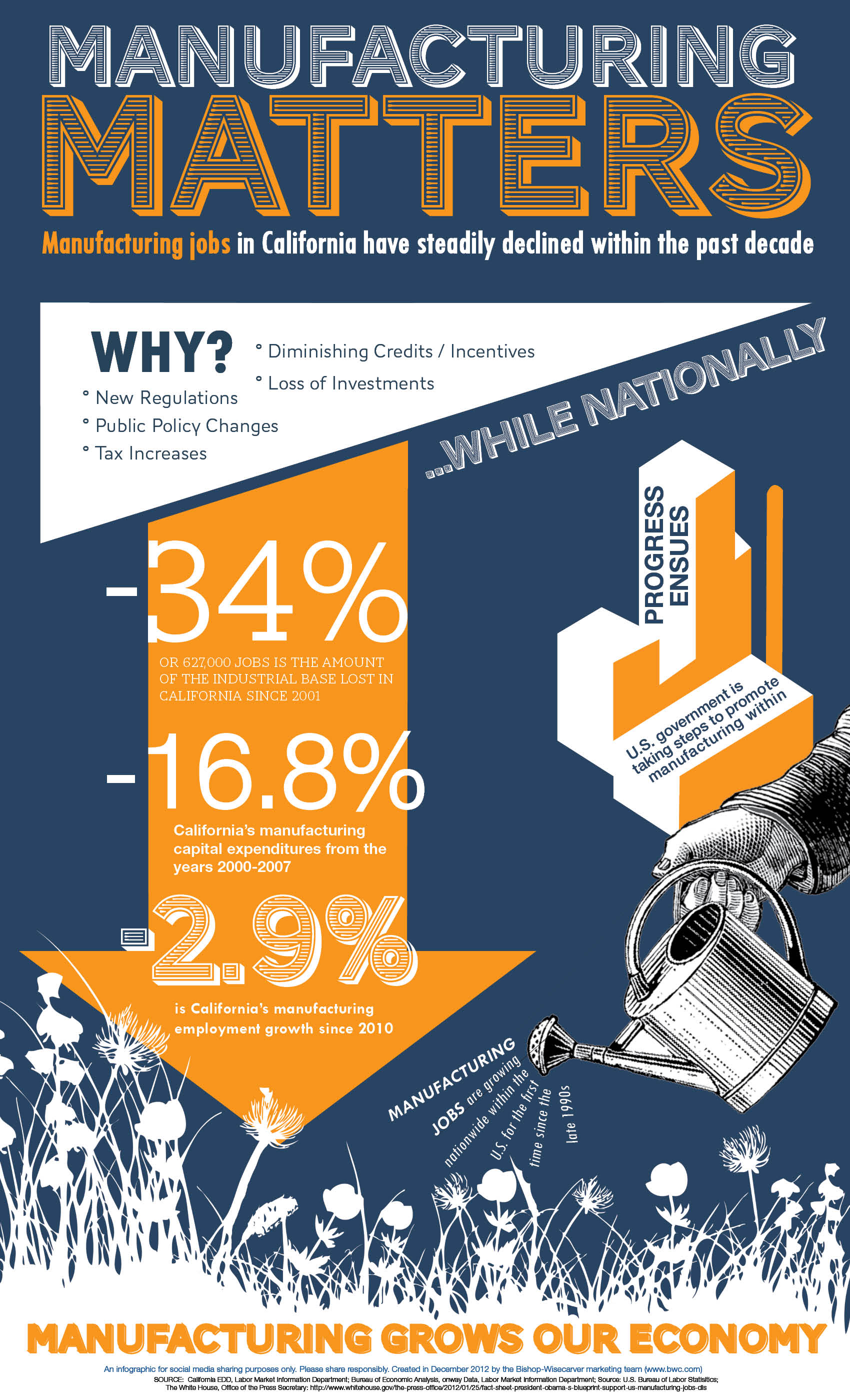
MANUFACTURING GROWTH — Since the early 2000s, California has seen a steady decline in manufacturing jobs — a loss of 79,000 between 2003 and 2007 alone, according to the California Manufacturing and Technology Association. Could heavy regulations be to blame? A report paid for by CMTA and released by the Milken Institute concludes exactly that, saying California's stringent rules force manufacturers to set up shop elsewhere.

Click here for the full image
During that same 2003-2007 time span when California shed massive amounts of manufacturing jobs, seven comparable states added some 62,000, the report continues. So how can California make itself more supportive of the industry that pays its workers an average annual salary of $66,000?

Part of what makes manufacturing in this state difficult is the quick changeover of labor laws, which makes it tough for companies to plan, the report says. Also, the fact that companies need approval from a complicated web of jurisdictions, which slows progress and could make a plan OK'd on the state level canceled by regional rules. Tax increases, investment losses and diminished credits and incentives add to the damage, the institute maintains.

If California had kept as many manufacturing jobs as it had in 2000, it would have seen 1.6 million more jobs and experienced $101 billion more in output by 2007, according to the report. That would translate into $75 billion more in wages than experienced in '07 and $5 billion more in income tax revenue. Obviously, the jobs exodus is nothing to sneeze at, and so the question remains: How to stop it?

STOPPING THE JOB DRAIN — Thankfully for the industry all about making things, some federal initiatives are in the works that aim to promote manufacturing across the nation. California manufacturing advocates are hoping it gives the Golden State an extra push to invest in its own companies.

President Obama unveiled a blueprint to promote domestic manufacturing and encourage companies to "insource" in lieu of "outsource".
  • First, the plan proposes removing tax deductions for outsourcing and add incentives to hire here at home. 
  • The incentive for insourcing would be targeted at companies that create jobs in the U.S. and the incentive would double for companies involved in advanced manufacturing.
  • Establish a tax credit for companies to invest in communities hit hard by the recession and job loss.
  • Provide temporary tax credits to green tech companies.
  • Reauthorize the right to expense any investment in plants and equipment.
  • Close loopholes that reward companies for investing abroad.
And there's more, but we'd like to turn the topic back to you. As a stakeholder in the manufacturing community, what's your assessment of the Milken report? What do you think of the presidential blueprint to support manufacturing as a nation? Do you think California can revive and sustain a thriving manufacturing sector by bringing jobs back home? Tell us in the comment box!

Friday, December 28, 2012

Top Five Twitter Posts: Flight of the Manufacturing CEOs, Infographics and the Innovation Killer


This is the final Twitter Friday post of 2012 — a fact that brought the year flashing before our eyes in a swirl of year-in-review retrospectives and memories of all kinds of breakthroughs in the world of manufacturing, rotary slides and linear guides, engineering and innovation in general. It's been quite the ride, 2012. Here's a look at some of our favorite moments on Twitter this week, as we gear up for the end of days ... er ... I mean the end of December! All kidding aside, chat us up on Twitter at @BWCnews!

1. The Executive Migration — CEOs Pack Up Their Desks via Manufacturing Executive Blog: An increasing number of chief executives are leaving their offices, a recent report found. Most of those departures could be chalked up to resignation, but 21 percent left had retired and about 17 percent stepped down but stayed on with the company as a lesser-ranking executive. If you're a CEO, do you plan to retire this coming year? Have you started to think about training or scouting for a successor? We'd love to hear your input!

2. New Infographics for Engineers on BWC.com: We made several new additions to our growing collection of infographics for engineers! Among them are a chart that debunks five myths about manufacturing and another that explores the much-talked-about manufacturing renaissance. Check it out, print them out and tell us ideas for future topics!

3. World's Longest High-Speed Rail Line Makes Debut via Shanghai Daily: The farthest-reaching high-speed train in the world made its 1,428-mile debut in China recently, according to the Shanghai Daily newspaper. The massive rail line spans half of China and travels at speeds of up to 186 mph. That super-fast addition to China's existing network of nearly 5,800 miles of railroads means the country now has the world's longest wall, the world's longest bridge and the world's lengthiest high speed rail.

4. The Patent Office — An Innovation Killer? via Manufacturing.net: A recent patent lawsuit filed by 3D Systems against Kickstarter and Formlabs contests the startup's right to manufacturing a successfully financed stereolithography 3D printer. "At first glance, this could easily be shrugged off," the article reads. "Really, patent lawsuits happen all the time, and it is rare that they blow up to anything huge for either side, other than some bragging rights and some lawyer's paychecks (see Samsung versus Apple for a counterpoint)." But lawsuits like this could hearken bad news for crowdsourcing platforms like Kickstarter and, in effect, the small businesses and start-ups that use that form of investment to get an idea off the ground. Your thoughts?

5.  Bringing Manufacturing Back to America on Times Call: "When we buy American, we build America," this columnist quotes a manufacturing as saying. And that's a good way to frame the issue as manufacturing executives consider how to balance a global market and, conversely, a need to become at least majority sourced USA. Click through to read the rest of the speech.

Monday, December 24, 2012

#MotionMonday: The Truth About Green Jobs


A GOOD KIND OF GREEN – Greening up the manufacturing space is obviously an important priority for businesses that value sustainability, lean manufacturing, improved efficiency and being better stewards of the environment. But there's a good kind of green that needs to be the focus, the kind that brings high-wage jobs in the long term to put our growing population to work. But when these "green" jobs require heavy government regulation and rely on subsidies, that ends up hurting the economy and stifling productivity.

The California Lutheran University Center for Economic Research and Forecasting recently released a report titled "The Truth About Green Jobs and California: A Review of the Costs, Risks and Trade-offs of Green Jobs Policies" that examines the difference between positive green job growth and its negative counterpart.

Click here for the original graphic
"Many within the media, academic and the economic development communities have expressed enormous enthusiasm about the prospects for green jobs as a result of strong environmental legislation," the executive summary reads. "Indeed, many claim that increased environmental regulation is a key to a newfound prosperity."

The report's aim is to cut through the hype, it says, to separate fact from fiction in the discussion about green jobs and how to regulate manufacturing to promote sustainability.

"One issue is defining a 'Green Job,'" the review continues. "Since data are collected in a way that makes it difficult to identify green jobs, researchers tend to classify certain industries as 'Green.' This necessarily requires either grossly underestimating the positive impact of green jobs, if one is too selective, or grossly overestimating them if too inclusive."

The California Manufacturing and Technology Association piggybacked on the university study to conclude that the "right" green jobs wouldn't sacrifice California's existing job base.

The right green jobs, per CMTA, are "new green product manufacturers, research and development jobs and service jobs that relate to purchases and installation of new green systems."

The wrong type of green jobs?

"Jobs created by policies that make it harder to retain and grow high wage jobs or that burden consumers with high costs."

What do you think of the report's findings and the CMTA's conclusion about which types are positive for California's economic growth? Tell us in the comment box!

Friday, December 21, 2012

Top Five Twitter Posts: Force of Manufacturing, Solar Panel Stickers and an Engineering Hero


Smack-dab in the middle of the holidays and we're still busy as ever in cyberspace and on the manufacturing floor, making conversation online and guided motion solutions at our Bay Area headquarters. It's an exciting time of year. Let us fill you in on some of the chatter that defined our Twitter conversations this week, from the funny to the fascinating. Make sure to follow our future tweets at @BWCnews!

Credit: Motion System Design
1. The Force of U.S. Manufacturing in Motion System Design magazine: The glossy publication put together a nice piece on the "new normal" of global manufacturing and the role domestic industry plays in the field's worldwide growth. On the panel cited in this article is BWC's very own Pamela Kan, CEO member of various public advisory panels. In it, Kan talks about, among other things, the importance of manufacturing products in the U.S., the meaning of productivity and how we can improve domestic manufacturing.

2. Peel-and-Stick Solar Panels via Product Design & Development Magazine: For the first time, scientists have found a way to create flexible solar cells, bendable enough to fashion into peel-and-stick patches. The developing vastly widens the application of solar technology, the magazine says. We've achieve "the ideal: flexible, decal-like solar panels that can be peeled off like Band-Aids and stuck to virtually any surface, from papers to window panes."

3. Boeing, BMW Join Forces on Manufacturing Executive Blog: Recent advances of new composite materials, namely carbon fiber, to build super lightweight cars and aircraft has led BMW and airline giant Boeing. We look forward to seeing the innovation the partnership will breed!

Credit: Big Beacon
4. The Jackhammer Elegies: A Novel with an Engineering Hero via Big Beacon: A few blogs posts ago, we suggested some pretty cool gift ideas for engineers. But here's another we'd like to retroactively add to the list. It's a book whose protagonist, Scott Carter, is a civil/structural engineer. Click through to read more about the novel in an interview with its author, Stefan Jaeger.

5. Skills Gap to Drive Manufacturing Power Shift via Manufacturing Engineering Media: While we talk about reshoring manufacturing and repatriating domestic profits, here's a piece that reminds us how a shortage of skilled laborers will keep pushing manufacturing overseas unless the U.S. comes up with a policy to counteract that. Do you think we'll see a formal U.S. manufacturing policy in 2013?

Monday, December 17, 2012

#MotionMonday: Gearing Up For the FIRST Robotics Kick-Off


STEM SUPPORTERS —
As strong supporters of STEM initiatives, we are always looking for opportunities where we can encourage our local science, technology, engineering and math students to do great things. One of the many ways we reach out to students is through FIRST, an annual robotics competition founded by Dean Kamen. During the 2013 program we are sponsoring three high school teams as Diamond Suppliers to the kit of parts — The Vacaville Robodogs, the Sacramento Fembots and the Brentwood Patriots.

Look for us in the 2013 program catalog
READY TO RUMBLE? — These teams will take part in a national contest that pits robots they design and build against those of other teams. FIRST robotics, the nonprofit organization that facilitates the months-long competition, aims to promote STEM education and foster future engineers and scientists by making STEM education fun and practical. We contribute guided motion components, financial aid and publicity to support some of our local teams.

This year's FRC kick-off takes place on Saturday January 5, 2013. We'll be covering the event at San Jose State University, where hundreds of students will compete in what marks the start of the design and build season. At the kick-off event students will, "compare notes, get ideas, make friends, find mentoring teams, learn the game, pick up the Kit of Parts and get geared up for the exciting competition seasons." (Credit: USFIRST.org).

VARSITY SPORT FOR THE MIND — The FRC season culminates in an intense competitive event that draws teams from all over the world to compete in large arenas in a competition that requires students' robots to achieve complex tasks. What makes the competition so fierce is that FIRST culls the best and brightest young minds to compete, and then there are the variables on game day: Will the battery run out? Will the machine malfunction? How to tackle those problems on game day while the clock keeps ticking?

The program teaches kids to think on their feet and dream up innovative solutions to immediate problems. That ingenuity lies at the heart of invention and engineering, it provides the foundation for a robust manufacturing sector because it fuels innovation. That's the spirit we aim to foster here. And that's why we support FIRST.

Friday, December 14, 2012

Top Five Twitter Posts: Made in America, Manufacturing Semantics and Facebook's BWC Year-in-Review


Just a few weeks left of 2012 — enjoy the last few days of the year! We've had quite the week on Twitter, sharing an article published by our company president, some manufacturing news, wishing students luck on their engineering finals and lots of other happenings. We'll spotlight a few of our favorite moments right here. Become part of the action by following this linear guide manufacturer on Twitter at @BWCnews!

Credit: Photo Cards Direct
1. December is 'Made in America' Month via Industry Week: Though we recognize the importance of the global economy and our increasing interconnectedness to industry in other countries, we also take pride in our heritage as an American manufacturer. According to Industry Week,  "A recent study by the National Retail Federation revealed that the average American will spend $700 in holiday purchases this year for a total of $465 billion. If that money was spent entirely on U.S. made products it would create 4.6 million jobs."

2. Is Manufacturing Still a Dirty Word? via Ideas Lab by GE: BWC President Pamela Kan shared her thoughts on the negative connotations surrounding the word — and the industry of — manufacturing. Does the younger generation perceive it as dirty, cheap and blue collar? How can we change that view to make them realize it's increasingly advancing, it's high-paying, it's a job to vie for and it's the backbone of our economy? A big thank you to the folks at General Electric for sharing Pamela's blog post this week!

3. Gift Ideas for Engineers via BWCnews.blogspot.com: Maybe you've already completed your holiday shopping, but in case you haven't, we've compiled a list of some gifts an engineer might enjoy. From visible-gear clocks to a piston coffee mug, these selections are sure to amuse the receiver ...and may be the talk of the office.

Credit: BWC
4. Bishop-Wisecarver Corporation Fan Page via Facebook.com: We celebrated a mini milestone later this week when we finally reached more than 400 fans on our Facebook page. Nice way to wrap up this mid-December week! Join us on there for updates, photo posts, polls and a running log of what we're up to throughout the week. Oh, and an added end-of-the-year bonus: Facebook compiled a Timeline of 2012 highlights for us. Reminisce with us here!

5. Six Things to Know About the Future of Manufacturing via The North Jefferson News: Understanding the evolution of manufacturing in the U.S. and abroad is key to understanding the trajectory of its future. That's why it's important to note that manufacturing is dynamic, it's diverse, that its future consumers live in the developing world as well as other insights shared in this article. Great read!

Monday, December 10, 2012

Gift Ideas for Engineers, Builders, DIY Makers


Have you finished all that holiday shopping for the engineer in your life? If not, here's our top five picks so far. In this Motion Monday edition we're featuring some of the coolest gadgets and trinkets shared with us on our social media channels — from the good and the great on ThinkGeek.com to all things found on Amazon.com. What sort of engineering fun did you find online this year?

1. Desktop Gear Clock: Got gears? It's a timepiece built out of a bunch of gears in various sizes, and we found it for a few dollars shy of $50 on Amazon.com — a great visual!

Credit: Amazon.com
2. Piston Mug: Need a gift for a mechanical engineer in your acquaintance? How about a handy coffee mug shaped like a piston? It's chrome-plated, dishwasher safe (but not microwaveable) and insulated to keep your favorite beverages hot or cold. And oh, Amazon, it's so hard to beat your prices ... we found one for $19.99 on the retail giant's online store.

3. Level Cufflinks: How about present that is stylish and practical? Check out these cuff links that double as level. The familiar neon liquid is bound to be appreciated by anyone with experience building things. Click through to find these cuff links offered by CuffCrazy for $30.

4. Ultimate 5-in-1 Pen: "The pen that makes all other pens quiver in inadequacy" — an amazing claim from our friends at Think Geek, right? Hyperbolic as it may seem, you can't help but be impressed the five geek tools crammed into one apparatus. You have a pen, stylus, LED flashlight and red laser pointer all in one convenient pen. Even more impressive? It's less than $10.

Credit: ThinkGeek.com
5. Pizza "Pi" Cutter: "Cut your pie with Pi," suggests Think Geek. "For such an irrational number, you sure are kind. You help us do all sorts of things — like figure out the area and circumference of our pizza. And now, with the power of future technologies, and combining things with other things, you will also be able to cut our pizza into pieces." We couldn't have said it better ourselves. If you you know a pizza lover who also appreciates the power of Pi, it's likely well worth the $15 to order them this cleverly make cooking utensil.

Friday, December 7, 2012

Top Five Twitter Posts: Linear Guides, Infographics for Engineers and Immortal Jellyfish


A product launch, a manufacturing renaissance, new breakthroughs in science and innovative perspectives on the state of our economy — those and other topics blipped across our radar this week. Just to capture some of that conversation, we've summed some of the most notable tweets here. Become part of the conversation, or suggest nominations for our next Twitter Friday installment, by tweeting us at @BWCnews. Happy holidays!

1. Download a Free QuickTrak® Linear Guide Catalog on BWC.com: We recently announced the launch of our latest product, a linear guide called QuickTrak. It's a line of modular cut-to-length and simple-to-build parts. And now, you can download the product catalog from our website!

www.bwc.com 
2. Infographics for Engineers on BWC.com: Throughout the year, we've steadily built up our collection of infographics geared for the engineering crowd. These are useful visuals that lay out information in an easy-to-digest printable poster formats. Our latest one explores the much-talked-about manufacturing renaissance. Click through to download, print and hang a copy at your workspace!

3. Jellyfish Might Prove Immortality a Possibility via Discover News: If you picked up a copy of the Sunday New York Times this week, you may have read the feature on how a scientist in Japan is exploring a specific type of reverse-jellyfish that may hold the secret of everlasting life. How much of the story's optimism toward the study is merited? Here's a science writer's interesting take on the phenomenon.

4. The Insourcing Boom in The Atlantic: Here's another story that got our Twitter friends yapping — one about the ever-growing trend of bringing manufacturing back to the U.S. from China. Is outsourcing an outdated business model? You tell us.

5. Is a Manufacturing Revival a National Security Necessity? on Manufacturing Executive Blog: People talk about having to build up a national manufacturing policy because the industry is so vital to the health of the economy as it generates jobs and acts even as a bellwether to the broader health of the nation. A report issued recently further underscores the importance of manufacturing by arguing that it's vital to national security and helps minimize damage in event of natural disaster — or at the very least speeds up recovery. Click through to read the blog and download the report.

Thursday, December 6, 2012

Watch, Read, Listen, Do: Engineering Roundtable, Re-shoring Manufacturing and Free Application Stories


Part of what encourages a forward-thinking and innovative culture is how well a business keep tabs on current events, new ideas and the trajectory of modern manufacturing. Every day we scourer social media channels for the good and the great — we're more than just your linear guide manufacturer! Here's a bit of what caught our interest in the world of science  manufacturing, engineering and technology.

Where do you dial in for the latest news?

[ WATCH ] The crew at Design World network held an editorial round table again, another installment in their new series in which the newsroom staff speaks with industry experts on a variety of engineering-related topics. Check it out and stay tuned for future episodes. Great idea, guys!

[ READ ] James Fallows writes in a recent Atlantic article, "For decades, every trend in manufacturing favored the developing world and worked against the United States. But new tools that greatly speed up development from idea to finished product encourage start-up companies to locate here, not in Asia. Could global trade winds finally be blowing toward America again?" What do you think?

[ LISTEN ] Did you know that the National Academy of Engineering has an online archive of audio podcasts related to the field? And they're free too, so tune in!

[ DO ] Designers, engineers and all-around thinkers and makers draw inspiration from many places in the world including from each other. That's why we're so fascinated by application stories — they tell us how someone else solved a solution that may be common to other people. Seeing how other people approach a problem can help us engineer a more refined solution as well. In that spirit of sharing and inspiration, we invite you to peruse our library of application examples and to download any number of them for free! These case studies examine applications in industries such as industrial machinery, medical device manufacturing, transportation, robotics and many more.

Monday, December 3, 2012

Q&A With Territory Sales Manager David Weise


Meet Bishop-Wisecarver's Newest Territory Manager David Weise
David joined the Bishop-Wisecarver team this fall, bringing to the group a lot of enthusiasm! He recently met some of our customers in the packaging industry at Pack Expo in October. If you're in his Midwest region and need help with anything related to linear guides and rotary motion systems, email him at davidw@bwc.com. Welcome to the team, David!

Question: Tell us a about your background, your education, how long you’ve been with Bishop-Wisecarver and what you like most about being on the BWC team?
Answer: I’ve spent the majority of my career in sales, marketing, and business development for technical products with service-oriented industrial companies. This has allowed me to work with both OEMs and end users in wide variety of industries from automotive and automation to packaging and pulp and paper. Along with quality products and a family working environment, one of the things that drew me to Bishop-Wisecarver is the market diversity in which our products are used, ensuring the potential for growth even when some markets are experiencing a downturn.

Question: What do you like about sales?
Answer: Sales is about helping the customer find a solution to a problem or a better way of accomplishing a task.  If I’m not adding any value to the customer there is no real reason to pick my products over a competitor's. Working as a partner with the customer helps create a solutions-based sales environment.

Question: What do you enjoy most about working with engineers?
Answer: Engineers usually have a specific and unique way of looking at projects, problems, and products. They need to be creative while often working within predefined constraints. I enjoy working with engineers as a partner to help optimize their process and hopefully remove some of their constraints through the use of my products.

Question: What challenges arise from selling a product based on features and benefits?
Answer: I think the biggest challenge is to not “sell” your product, but rather to listen to the customer to find out his specific needs or problems. Once you know your customer’s objectives, you can talk about the definite features and benefits that address those needs.

Questions: What makes for a good selling relationship with a customer?
Answer: People buy from people. They tend to do more business with people and products they believe they can count on. Trust is the key element, along with follow-up and following through.

Question: If sales were a team sport, what would it be and why?
Answer: Basketball.  Each member on the team, on their own, is capable of scoring. But the true victories come when the team members work together, assisting each other toward the common goal.

Question: Speaking of sports, what’s your favorite team or teams?
Answer: The Green Bay Packers, of course.

Question: What do you like to do outside of work?
Answer: I enjoy spending time with my wife and family, travelling to tropical climates (especially during the Wisconsin winter months), and am a certified scuba diving instructor (during the Wisconsin summer months).

Question: What’s your favorite coffee beverage? Cream, no cream, sugar, no sugar?
Answer: I like my coffee dark roast, black, and plentiful.

Question: Favorite quote?
Answer: “From what we get we make a living. From what we give we make a life.”  — Winston Churchill